
By SIERA.AI · June 11, 2026 · 8 min read · Forklift Safety · EHS · Warehouse Analytics
Every EHS manager knows the feeling: you’ve posted stop signs, installed blue safety lights, and run operator training — and yet near-misses keep happening. The honest truth is that traditional reactive safety measures do not stop accidents. People keep making the same mistakes because those tools address symptoms, not root causes.
In 2026, the warehouses achieving true zero-incident milestones have moved from reactive to proactive. That means deploying a fully integrated forklift safety system that detects hazards in real time, locks out unauthorized operators, and feeds every data point into a single analytics dashboard so managers can act on patterns — not just paperwork.
|
$188K
Average cost of a single forklift injury
|
1.1M+
Near-miss incidents tracked in one year
|
30ms
Vision AI scan frequency for pedestrians
|
<30m
Install time on any gas, electric, or LP forklift
|
The Real Reason Traditional Safety Programs Fail
|
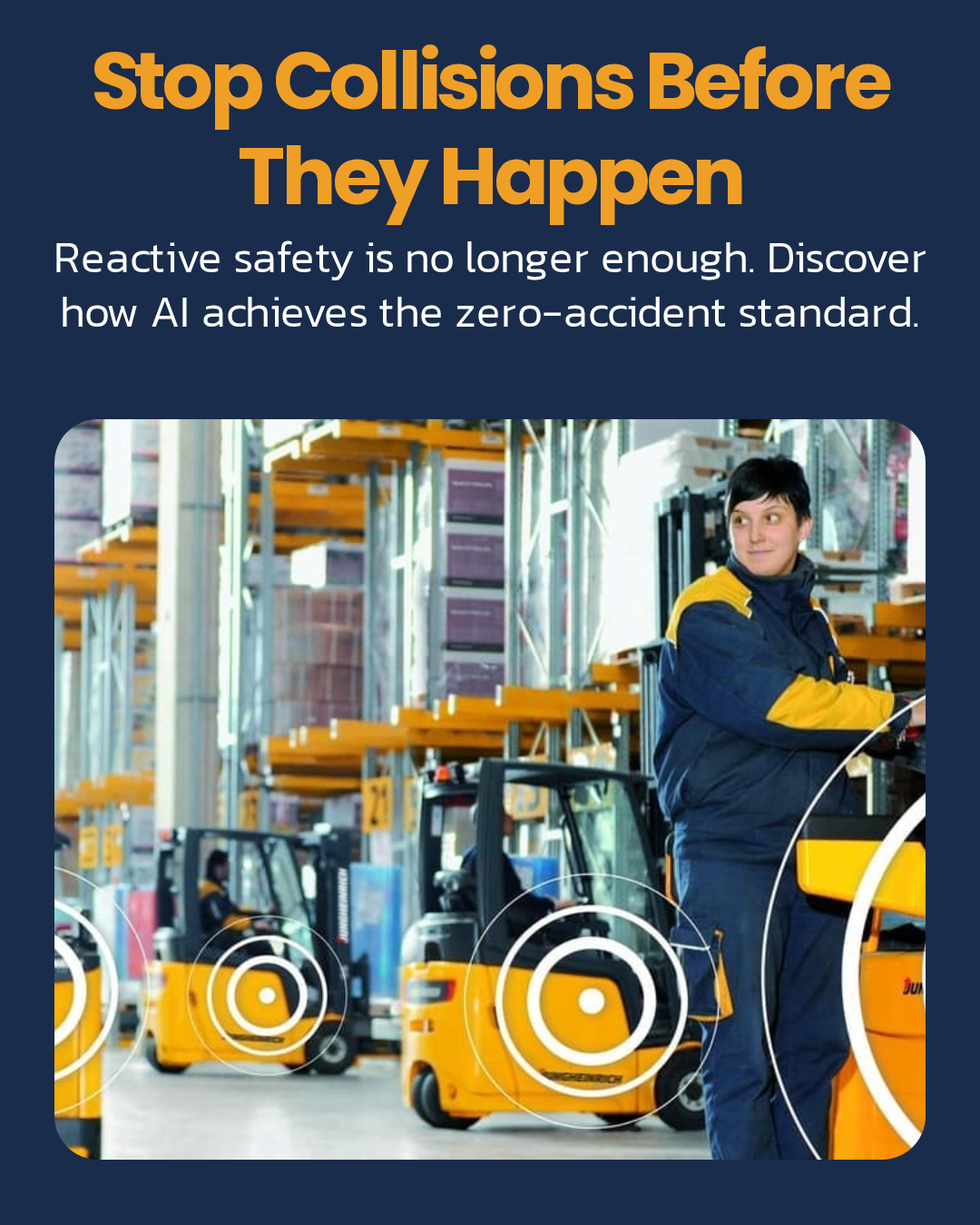
Stop signs, yellow floor paint, blue spotlights — these are visibility tools. They rely entirely on the assumption that operators and pedestrians will always look, always notice, and always react in time. In a busy distribution center where a forklift moves at 8–10 mph under a full load, that assumption is simply not safe enough. OSHA estimates roughly 85 forklift fatalities and nearly 35,000 serious injuries occur in U.S. workplaces every year — at facilities that already had safety programs in place. Those programs were reactive. They documented accidents rather than preventing them. Shifting to proactive safety requires three things: a sensor that detects hazards faster than human reflexes, an access control layer that keeps unqualified operators off equipment, and an analytics layer that turns raw data into decisions. Remove any one layer and you leave a gap an accident can walk right through. |
Layer 1 — Forklift Pedestrian Safety: Vision AI That Sees What Operators Miss
|
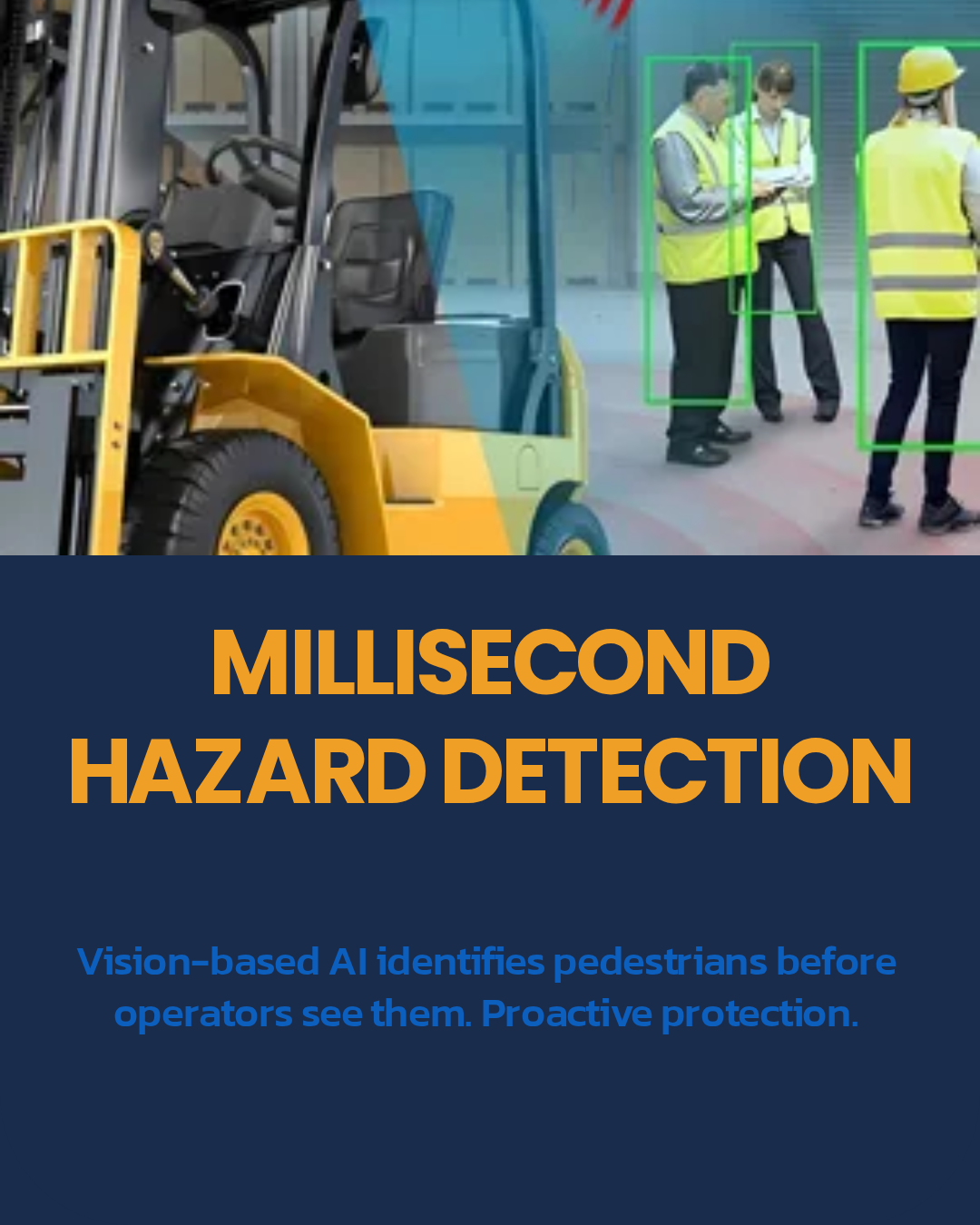
The foundation of any modern forklift safety strategy is the pedestrian detection system. SIERA.AI’s forklift pedestrian safety solution uses deep-learning Vision AI — not RFID tags, not wearables — to detect every person in the danger zone around the truck, every 30 milliseconds. The S3 Pedestrian Detection System doesn’t just flag someone standing in a lane. It identifies a person bending, stooping, crawling, or only partially visible — even when only a hand or foot is exposed behind a box. The operator receives an immediate audio alarm plus a visual symbol so they can react correctly. Works across all Class I–V vehicles. SIERA.AI tracked over 1.1 million near-miss events at customer worksites in a single year — each a potential serious injury caught before it became a claim. |
|
|
🧍
Full View Detection |
🤸
Bending & Stooping |
📦
Partially Hidden |
🏗️
Object Detection |
Layer 2 — Forklift Safety System: Access Control That Closes the Human-Error Gap
|
Even the best pedestrian detection system cannot compensate for an unqualified operator behind the wheel. That’s why the second layer of a complete forklift safety system is electronic access control — SIERA.AI’s Forklift Lock-Out. Before any forklift powers on, the operator must authenticate with a unique PIN or authorized work badge. The system then requires a completed digital OSHA-compliant pre-shift inspection checklist. No completed inspection — no movement. This single gate eliminates two of the most common root causes of forklift incidents: unqualified operators and skipped pre-shift checks. Dashboard administrators can shut down or start up any forklift remotely. Real-time push notifications fire the moment an unauthorized access attempt is made, an inspection fails, or an impact event is recorded — with a time-stamped operator photo at every incident. |
Layer 3 — Metrics & Analytics: The Telemetry Dashboard That Drives Decisions
|
Accidents don’t happen randomly — they happen at patterns. Specific intersections, specific shifts, specific operators. The only way to find those patterns is data, and the only way to act efficiently is a purpose-built dashboard. SIERA.AI’s metrics and analytics telemetry dashboard is the command center for your entire safety program. Every impact, near-miss, access event, and inspection feeds into a single live interface — viewable by asset, operator, worksite, or full fleet in real time. Workers’ comp premiums are calculated on your three-year claims history. Documented, time-stamped sensor data gives EHS managers real leverage to negotiate lower premiums directly with their insurer. |
|
|
💥
Impact Classification |
⚠️
Near-Miss Tracking |
🔒
Unauthorized Access Log |
📋
OSHA Compliance Reports |
2026 Comparison: Reactive vs. Proactive Forklift Safety
How a reactive approach stacks up against an AI-powered proactive system across the metrics EHS leaders care about most.
| Safety Metric | Reactive (Signs, Lights, Audits) | Proactive AI System (SIERA.AI) |
|---|---|---|
| Pedestrian detection speed | Human reaction ~200–300ms | ✔ Vision AI every 30ms |
| Partial / hidden pedestrian detection | ✘ Not possible | ✔ Detects hand, foot, partial body |
| Unauthorized operator prevention | ✘ Policy-based only | ✔ Electronic lockout — PIN or badge |
| Pre-shift inspection enforcement | ✘ Paper-based, easy to skip | ✔ Digital, OSHA-compliant, required to start |
| Near-miss data capture | ✘ Self-reported, under-counted | ✔ Automatic — 1.1M+ events per year |
| Impact severity classification | ✘ Post-incident only | ✔ Real-time low/medium/high + photo |
| Remote fleet shutdown | ✘ Not available | ✔ Any device, via dashboard |
| RFID tags or wearables required | N/A | ✔ None — Vision AI only |
| Forklift class compatibility | Partial | ✔ Class I–V, all fuel types |
| Workers’ comp premium leverage | ✘ No insurer data | ✔ Documented trend data for negotiation |
| Installation time | Days to weeks | ✔ Under 30 minutes, 3 steps |
| AI / ML continuous improvement | ✘ No | ✔ Deep learning improves over time |
Why 2026 Is the Inflection Point for Warehouse Safety Technology
1. OSHA enforcement is tightening. Forklift-related citations consistently rank in OSHA’s annual top-10 most-cited violations. Facilities still relying on paper checklists face growing citation risk. An electronic, time-stamped inspection trail is now your first line of legal protection.
2. Labor market volatility makes access control essential. High turnover in warehouse roles means new or temporary workers attempting to operate uncertified equipment is a real and growing problem. Without electronic lockout, there is no reliable gate between an unqualified worker and a moving forklift.
3. AI-powered search is changing how safety buyers decide. In 2026, EHS managers get direct answers from AI search engines rather than browsing ten blue links. Facilities that invest in documented, measurable safety outcomes now are building the track record that informs both regulatory and procurement decisions going forward.
Frequently Asked Questions
What is a forklift safety system?
An integrated combination of hardware and software — a Vision AI pedestrian detection sensor, electronic access control, and a real-time telemetry dashboard — designed to prevent forklift accidents before they happen rather than documenting them after the fact.
Does forklift pedestrian detection require RFID tags or wearables?
No. SIERA.AI’s S3 uses deep learning Vision AI mounted on the vehicle to independently identify and differentiate people from objects in real time — nothing for your workers to carry or wear.
How much does a forklift injury actually cost an employer?
Up to $188,000 per incident when direct costs (medical, legal, OSHA fines) and indirect costs (lost productivity, investigation, retraining, workers’ comp premium increases) are combined.
What forklift classes and fuel types are supported?
All five classes — Class I through Class V — on gas, electric, and LP vehicles, regardless of make or model. Installation takes under 30 minutes in three steps.
How does the telemetry dashboard reduce workers’ compensation costs?
Premiums are calculated on your three-year claims history. The dashboard provides time-stamped trend data — fewer near-misses, fewer impacts, lower incident rates — that EHS managers present directly to insurers to negotiate lower premiums.
The Zero-Accident Warehouse Is an Engineering Problem — Not an Aspiration
The facilities hitting zero-incident milestones in 2026 aren’t doing it through stronger memos or more posters. They’re treating forklift safety as a systems engineering challenge: detect faster than human reflexes, prevent access before a mistake can occur, and measure everything so patterns get corrected before they become injuries.
The three layers work together. Forklift pedestrian safety Vision AI catches what operators physically cannot see. A complete forklift safety system with electronic lockout closes the unauthorized-access gap. And metrics and analytics turn that data into decisions that improve safety scores quarter over quarter — with documentation to prove it.
Trusted by 3M, Grainger, DB Schenker, and Geodis. Installs in under 30 minutes. Results from day one.
Ready to See a Zero-Accident Facility?
Get a free, custom quote — no RFID tags, no disruption, results from day one.