
Implementing AI-Driven Collision Avoidance in 2026
The landscape of industrial safety in the United States is undergoing a seismic shift. As of May 2026, the integration of Artificial Intelligence into warehouse safety equipment has moved from “emerging tech” to a standard operational requirement.
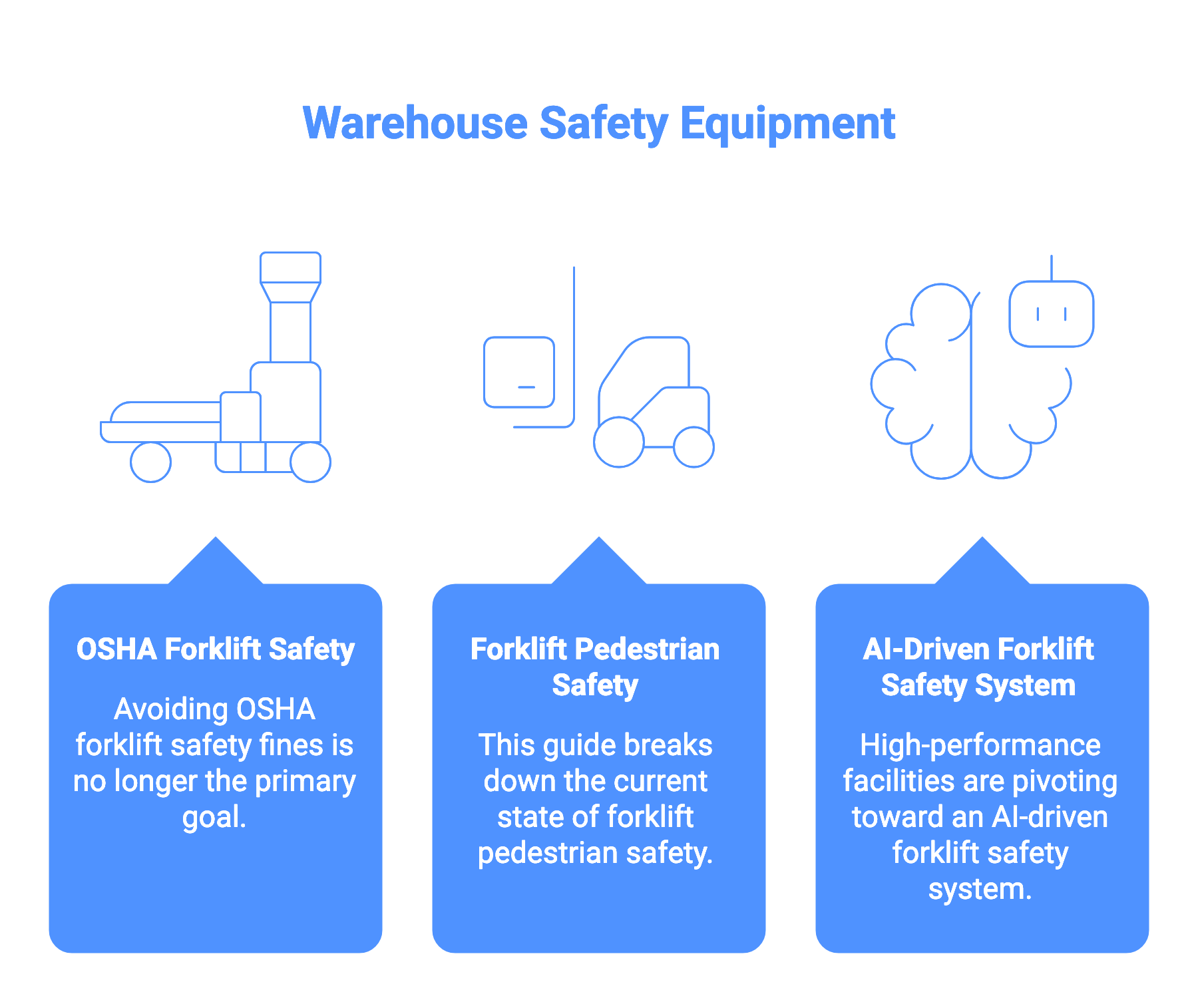
For facility managers from California to New York, the goal is no longer just avoiding OSHA forklift safety fines — it is the pursuit of a “Zero-Incident” workplace. This comprehensive guide breaks down the current state of forklift pedestrian safety, the economic impact of accidents, and why high-performance facilities are pivoting toward an AI-driven forklift safety system.
To understand the necessity of a forklift anti-collision system, we must look at the hard numbers. Despite increased awareness, the density of modern warehouses has made the floor more dangerous than ever.
| Metric | 2024/2025 Statistics | 2026 Market Projections | Impact Level |
|---|---|---|---|
| Annual OSHA Severe Injuries | 9,034 Reports | ~10,000+ (Projected) | High risk in e-commerce |
| Avg. Cost per Major Incident | $188,000 | $200,000+ | Includes legal & downtime |
| OSHA Serious Violation Fine | $16,550 | $16,550+ (Per violation) | Non-negotiable |
| Willful/Repeat Violation Fine | $165,514 | $165,514 | Extreme financial risk |
| AI Safety Market Value | $8.5 Billion | $9.7 Billion | Rapid technology scaling |
Data Source: Based on U.S. Bureau of Labor Statistics (BLS) and 2026 Industry Forecasts.
For decades, OSHA forklift safety meant two things: operator certification (Standard 1910.178) and a daily paper checklist. While these are mandatory, they are reactive. A paper checklist doesn’t stop a forklift from hitting a pedestrian in a blind spot at 3:00 PM on a Friday when fatigue sets in.
Modern warehouse safety equipment must address the “Human Factor.” Humans get tired, distracted, or suffer from “repetition blindness.” An AI-driven forklift safety system acts as a digital co-pilot that never blinks, providing a 360-degree safety net around the vehicle.
The industry has evolved through three distinct “Eras of Safety.” Understanding where your facility stands is the first step toward optimization.
1. The Passive Era (Pre-2010)
Relied on tape, signs, and the “honk at every corner” rule. It was 100% dependent on human compliance.
Success Rate: Low.
2. The Active/RFID Era (2010–2024)
Systems used RFID tags or magnetic sensors. If a worker wore a tag, the forklift would beep.
Success Rate: Moderate.
3. The AI & Vision Era (2025–Present)
SIERA.AI uses Computer Vision to recognize the human form without needing tags or vests.
Success Rate: Highest.
When you install a modern forklift anti-collision system, you are turning a “dumb” machine into an intelligent asset. The SIERA.AI S3 system, for instance, monitors the environment every 30 milliseconds.
- Human Detection: The AI identifies human skeletal structures. It can detect a person even if they are crouched behind a pallet or partially obscured.
- Proximity Zoning: The system creates “Safety Bubbles.”
- Warning Zone: Audio alerts to the operator and pedestrian.
- Critical Zone: Intense alerts and automatic speed reduction.
- Digital Accountability: Every “Red Zone” breach triggers a video recording for safety manager coaching.
Pro Tip for 2026: Don’t just detect; intervene. The most successful facilities link their AI vision directly to the truck’s speed controller, ensuring the machine slows down even if the operator is momentarily distracted.
Many CFOs see safety as an expense. However, in the high-velocity USA market, safety is a profit-protection strategy.
ROI Breakdown for a 20-Forklift Facility:
- Insurance Savings: Average 12–18% reduction in workers’ comp premiums through documented “zero-incident” data.
- Maintenance Savings: 20–30% reduction in repair costs by eliminating “fender benders” and racking clips.
- Compliance: 100% “Audit-Ready” digital logs, eliminating the risk of paper-based “pencil-whipping.”
In the competitive USA market, a safe warehouse is a fast warehouse. By moving beyond basic OSHA forklift safety and embracing a comprehensive forklift safety system, you protect your most valuable asset — your people — while simultaneously boosting your bottom line.
The most effective system is Vision-based AI. Unlike RFID, Vision AI identifies pedestrians automatically without requiring wearable tags. Systems like SIERA.AI provide proactive alerts and real-time data tracking, which are proven to reduce accidents by up to 90%.
These systems use high-speed cameras and edge computing to detect risky behaviors — such as excessive speed or pedestrians in blind spots — in less than 300 milliseconds. By providing haptic or audio warnings before a collision occurs, they bridge the gap between human reaction time and mechanical speed.
Yes. In 2026, OSHA has shifted toward favoring “behavioral monitoring technology.” AI systems like the SIERA.AI S3 automate the daily safety inspections and create an immutable digital log of pre-start checks and impact events, providing a robust paper trail for federal auditors.
A single forklift injury in 2026 can cost a company upwards of $200,000 in direct and indirect costs. This includes medical expenses, downtime, and OSHA fines, which now start at over $16,000 for serious violations and exceed $160,000 for repeat offenses.