
The Complete Guide to Forklift-Pedestrian Safety
The modern material handling landscape requires more than basic visibility; it demands real-time tracking, proactive accident prevention, automated regulatory compliance, and streamlined maintenance loops. By integrating advanced telematics and artificial intelligence (AI), industrial facilities can transition from reactive incident management to a predictive, fully optimized safety culture.
Deploying interconnected digital tools—ranging from telemetry tracking to telemetry-driven safety cameras and asset maintenance software—enables companies to systematically eliminate operational blind spots, reduce equipment damage, and maintain unbroken compliance records.
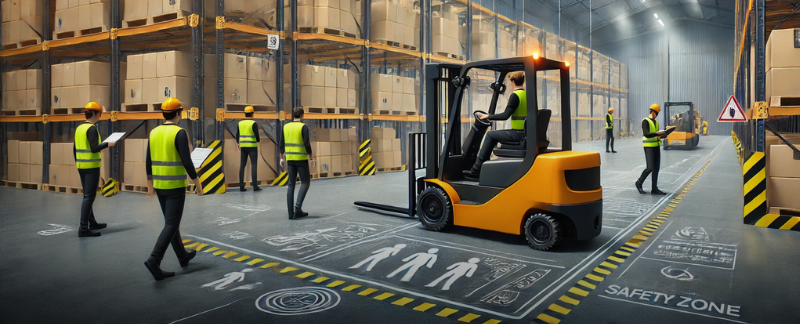
Managing a high-throughput warehouse floor requires comprehensive visibility into asset utilization, driver accountability, and physical inventory movement. Integrating a robust Forklift Monitoring System allows safety managers and fleet administrators to capture micro-level telemetry data and transform it into macro-level operational insights.
Traditional key-ignition forklifts carry an inherent safety risk: unauthorized or untrained personnel can operate heavy machinery without oversight. Next-generation tracking solutions solve this through digital access control. Before an engine can turn over, operators must authenticate via:
- RFID Badge Scanning: Workers tap their existing corporate ID credentials directly against an on-vehicle telemetry terminal.
- Biometric Authentication: Face or fingerprint recognition verifies that the individual matching the login is currently certified for that specific vehicle class.
- PIN Code Portals: Unique numeric passwords tied directly to local Learning Management Systems (LMS) ensure that if an operator’s certification has expired, the telemetry system locks the ignition automatically.
When an asset collides with structural racking, product inventory, or another vehicle, operators often fail to report the incident due to fear of disciplinary action. Telemetry monitoring solves this by embedding tri-axial G-force sensors directly into the vehicle’s chassis.
When an impact exceeds a pre-configured fractional G-force threshold, the system triggers a series of automated safety protocols:
- Immediate Vehicle Deregistration: The forklift automatically switches into a “creep mode” or shuts down safely, requiring a supervisor’s physical or digital override key to resume operations.
- Automated Cloud Alerts: An instant SMS or email notification containing the exact timestamp, impact force, vehicle ID, and operator name is pushed to facility managers.
- Black-Box Style Video Buffering: The system cross-references the telemetry spike with connected camera feeds, automatically clipping and preserving the 15 seconds before and after the collision for objective root-cause analysis.
While tracking systems capture backend data and control vehicle access, preventing active, live-motion collisions on a dynamic warehouse floor requires real-time edge computing. Upgrading standard material handling fleets with an AI-driven Forklift Safety System addresses the primary root causes of industrial workplace injuries: human error, visibility blocks, and slow human reaction times.
Older proximity solutions rely on magnetic fields or radio frequency (RF) tags. While effective in specific structural layouts, tag-based infrastructure requires every single pedestrian, visitor, and vendor to wear a physical, active beacon at all times. If a worker forgets their badge, they are invisible to the system.
Advanced machine vision safety systems bypass this restriction by using on-vehicle camera lenses paired with convolutional neural networks (CNNs). The edge-AI processor recognizes the distinct structural shape of a human body—regardless of whether they are walking, crouching, wearing high-visibility vests, or facing away from the vehicle.
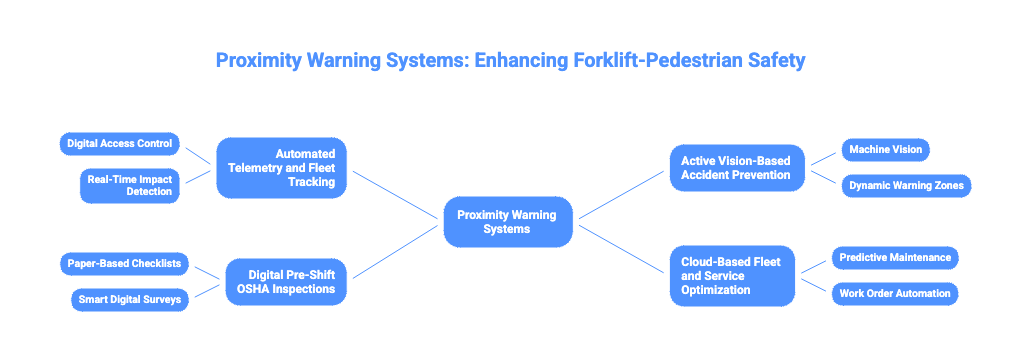
To minimize false alarms and prevent operator desensitization, vision-based safety processors calculate the trajectory, speed, and distance of surrounding objects simultaneously. The safety field is dynamically mapped into progressive risk profiles:
- Green Zone (Proximity Awareness): The system detects stationary infrastructure like pallets or walls. No alarm triggers, allowing smooth navigation in tight aisles.
- Yellow Zone (Caution Hazard): A pedestrian enters the peripheral monitoring path. A low-frequency visual indicator alerts the operator to exercise caution.
- Red Zone (Critical Collision Path): A human worker steps directly into the path of a moving or reversing forklift. The system instantly sounds a distinct, high-decibel audio warning and flashes dynamic LED strobes, giving both the operator and pedestrian a multi-second window to halt.
A safe work environment begins before a vehicle ever moves. Regulatory agencies like OSHA require comprehensive, documented pre-shift equipment inspections for every industrial vehicle before the start of every single work shift. Transitioning from paper checklists to digital Preshift Forklift Checks eliminates administrative overhead while drastically increasing inspection accuracy.
Paper logs are highly prone to operational liabilities:
- “Pencil Whipping”: Operators check off every safety box rapidly without physically inspecting the components to hit their operational deadlines faster.
- Loss and Degradation: Paper records get stained by hydraulic fluid, misplaced in physical filing cabinets, or illegibly filled out.
- Delayed Maintenance Triggers: If a driver notices a frayed seatbelt or a slow hydraulic leak, that piece of paper may sit in an inbox for days before a maintenance technician reads it, exposing the company to severe liability in the interim.
Digital pre-shift applications run directly on the vehicle’s mounted telemetry display or an operator’s mobile tablet. The inspection software introduces structural parameters that guarantee authentic compliance:
- Randomized Question Sequencing: To combat muscle-memory cheating, the software randomizes the order of the check items every day.
- Time-Delayed Inputs: The system monitors the speed of the submission. If an operator attempts to complete a 20-point mechanical check in under 30 seconds, the application flags the attempt as fraudulent and alerts management.
- Mandatory Photo Documentation: If an operator marks a component as “failed” (e.g., a cracked tire tread or broken indicator bulb), the software requires a real-time photo upload before the ticket can be submitted, providing maintenance crews with instant visual context.
The final pillar of a robust material handling ecosystem involves translating data patterns from tracking hardware and pre-shift inspections into actionable asset management strategies. Implementing dedicated Service Management Software centralizes all mechanical maintenance logs, warranty data, and repair schedules into a unified digital workspace.
Waiting for a forklift’s transmission to fail before scheduling a repair leads to expensive emergency shipping costs, lost floor productivity, and unsafe operating conditions. Service management software analyzes real-time engine run-time hours compiled automatically via vehicle telematics to establish a dynamic, usage-based service calendar.
Instead of performing oil changes or mast lubrications strictly based on arbitrary calendar dates, the cloud system schedules mechanical interventions precisely when the individual vehicle approaches its operational milestone. This extends total equipment lifespans while lowering total cost of ownership (TCO).
When a vehicle fails a digital pre-shift check or encounters a critical telemetry impact, the cloud software bypasses manual communication entirely:
- Auto-Generation of Work Orders: A triage ticket is automatically created within the service system, detailing the precise diagnostic error code or mechanical failure.
- Parts Availability Matching: The system cross-references the required fix against internal parts inventory. If a replacement hydraulic seal or brake pad is out of stock, it drafts an automated purchase order for procurement approval.
- Technician Scheduling Optimization: Work orders are routed directly to the specific internal technician or external service contractor specializing in that vehicle make and model, minimizing machine downtime and maximizing operational turnaround.
A: By replacing traditional key ignitions with digital access controls, a Forklift Monitoring System ensures that only certified personnel can operate machinery. It logs every user session and tracks driving behavior, tracking G-force impacts down to the exact second, vehicle, and operator to eliminate unreported workspace accidents.
A: Yes. Unlike older RFID or magnetic tag platforms, an advanced Forklift Safety System uses AI-driven machine vision cameras to identify the physical shape of a human being. This means the system protects everyone on the floor automatically, including visitors, vendors, or staff who forget their high-visibility vests or tags.
A: When a critical safety issue (such as a brake failure or hydraulic leak) is reported during Preshift Forklift Checks, the software instantly engages an ignition lockout. The vehicle cannot be driven until an authorized technician addresses the issue and clears the maintenance flag within the system.
A: By tracking real-time engine hours via telematics, Service Management Software shifts your facility from reactive repairs to predictive maintenance. Servicing parts based on actual wear and tear rather than arbitrary calendar dates prevents catastrophic mechanical failures, extends vehicle lifespans, and reduces unplanned warehouse downtime.