
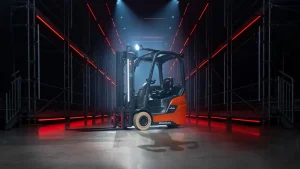
The New Standard for Industrial Safety
In the high-velocity world of modern logistics, industrial safety is no longer a reactive checklist—it is an active data stream. As North American facilities scale and human-machine interaction becomes more frequent, the integration of intelligent object/pedestrian detection and forklift AI has evolved from a “nice-to-have” into the bedrock of operational excellence.
Beyond the Mirror: What is Modern Forklift AI?
Forklift AI is an enterprise-grade intelligence layer that sits between your fleet and your facility. By utilizing computer vision, LiDAR, and high-frequency sensors, these systems do what a human supervisor cannot: they watch every corner, every second. Unlike traditional RFID tags that require every worker to wear a device, vision-based pedestrian detection identifies the human form regardless of what they are wearing, identifying hazards—such as a worker crouching behind a pallet—and intervening before a tragedy occurs.
The Evolution of Warehouse Protection
| Feature | Traditional Safety | Forklift AI (siera.ai) | 2026 Impact |
|---|---|---|---|
| Collision Avoidance | Mirrors & horns | Computer Vision | 90% accident reduction |
| OSHA Compliance | Paper logs | Digital logs | 100% audit-ready |
Why the USA Market is Transitioning
Modern pedestrian detection solves the three most expensive pain points in the supply chain:
- 1. AI Proximity Awareness: Triggers automatic speed reduction in high-traffic zones.
- 2. Eliminating “Pencil-Whipping”: Biometrically verified digital pre-shift inspections.
- 3. Predictive Risk Modeling: Uses heatmaps to identify “hot zones” proactively.
FAQ: Safety & Automation in 2026
How does pedestrian detection improve forklift safety?
It uses real-time computer vision to detect pedestrians in blind spots and automatically slows the vehicle.
Do workers need to wear tags?
No. Modern forklift AI uses human-form recognition to protect everyone, including visitors.