

OSHA 1910.178 legally permits electronic pre-shift forklift inspections provided the digital system verifies equipment condition before operation, creates an auditable record, and prevents defective trucks from running. Switching from paper sheets to digital inspection apps eliminates pencil-whipping, automates instant lockouts, and produces time-stamped proof that withstands federal safety audits. Paper Checklists vs. Digital Inspection SoftwareThe operational differences between legacy paper inspection forms and modern digital inspection software show why facilities are rapidly retiring clipboards:
|
Why Paper Pre-Shift Forklift Inspections Fail Safety Audits
Under OSHA Standard 29 CFR 1910.178(q)(7), industrial lift trucks must be examined before being placed in service. They must be inspected at least daily, or after each shift if used round-the-clock.
Despite this federal mandate, warehouse floors routinely rely on clipboards, soggy carbon copies, and binders overflowing with illegible handwriting. This reliance creates systemic compliance vulnerabilities:
Pencil-Whipping Epidemic: Operators tick identical checkmarks down a 25-item paper checklist in under 15 seconds without walking around the carriage or testing the horn.
The Inspection Gap: When an operator marks a cracked hydraulic hose on paper at 6:15 AM, that clipboard often hangs on the cage until 3:30 PM. The truck runs an entire shift with a catastrophic failure risk.
Lost Audit Trails: Carbon copies get covered in hydraulic oil, torn off clipboards, or misplaced. When an OSHA compliance safety and health officer (CSHO) requests records following an incident, missing paperwork converts a clean record into an instant citation.
“In our forensic safety evaluations, over 68% of paper-based forklift inspection logs recovered after workplace tip-overs or brake failures showed clean, straight-line checkmarks dated the morning of the incident—classic pencil-whipping that failed to protect the operator or the employer.”
— Marcus Vance, CSP

The 5 Critical Questions Warehouse Managers Ask About Forklift Inspections
Transitioning from clipboards to cloud workflows raises crucial regulatory and operational considerations. Here is what fleet supervisors must know:
1. Does OSHA 1910.178 legally permit electronic or digital pre-shift forklift inspections?
Yes. OSHA standard 29 CFR 1910.178 does not mandate paper documentation. OSHA’s formal standard interpretation letters confirm that electronic pre-trip inspection records satisfy federal requirements, provided the digital platform accurately captures all equipment conditions, identifies the individual operator, generates a verifiable time stamp, and makes historical logs accessible to inspectors upon request.
2. What happens if a forklift operator pencil-whips or skips daily pre-use inspection sheets?
Failing to conduct pre-shift inspections or falsifying logs exposes an organization to severe legal and financial penalties:
- OSHA Willful & Serious Citations: If an uninspected forklift causes an injury or property damage, OSHA can issue penalties exceeding $161,000+ per willful violation under updated enforcement tiers.
- Worker Endangerment: Mechanical failures like brake fluid loss, severed mast chains, or tire chunking cause preventable tip-overs and struck-by collisions.
- Pierced Corporate Liability: Subpoenaed paper logs with straight-lined checkmarks demonstrate willful negligence in civil litigation, stripping away standard liability protections.
3. What critical items must be included in a daily electric forklift pre-trip inspection checklist?
An electric powered industrial truck requires two distinct inspection tiers before operation:
├── 1. Static Key-Off Visual Walkaround
│ ├── Overhead guard & load backrest integrity
│ ├── Hydraulic cylinders, hoses & mast chains (no leaks, uniform tension)
│ ├── Forks: Heel integrity, surface cracks, lock-pin engagement
│ ├── Tires: Chunking, bond separation, embedded debris
│ └── Battery: Cable insulation, vent caps, connector latch, electrolyte levels
└── 2. Dynamic Key-On Operational Check
├── Instrument gauges & state-of-charge (SOC) indicators
├── Audio & visual warning alarms: Horn, strobe lights, backup chime
├── Steering assembly: Free play, binding, smooth response
├── Full hydraulic cycle: Hoist, lower, tilt forward/back, side-shift
├── Braking systems: Service foot brake, dead-man pedal, emergency disconnect
└── Seatbelt & operator restraint interlocks
4. How do digital inspection apps lock out a forklift if a critical safety defect is flagged?
Digital inspection platforms utilize a closed-loop lockout protocol to prevent defective equipment from moving:
- Immediate Critical Classification: Items are tagged as Minor (e.g., scuffed decal) or Critical (e.g., brake pedal sponge, cracked fork heel, exposed battery cable).
- Telemetry Interlock & Telematics Disabling: In facilities with connected vehicle telematics (CAN bus relays), flagging a critical defect immediately disables the truck’s ignition or drive circuit remotely.
- Digital Tag-Out: The operator’s tablet or smartphone screen turns red, displaying an OSHA-compliant digital “DANGER — DO NOT OPERATE” placard.
- Instant Maintenance Escalation: The software dispatches automated SMS/email alerts with attached photographic evidence to fleet mechanics to initiate standard Lockout/Tagout (LOTO) protocols.
5. How long must a warehouse keep historical daily forklift inspection records for OSHA audits?
While OSHA 1910.178 does not designate an explicit retention calendar for daily operator check sheets (unlike 30-year medical surveillance logs), EHS industry best practice and legal precedent dictate retaining daily inspection records for a minimum of 12 months. If an incident occurs, those logs must be retained until all workers’ compensation cases, insurance reviews, and OSHA litigation windows close completely. Cloud-based digital platforms store these records indefinitely at zero physical footprint.
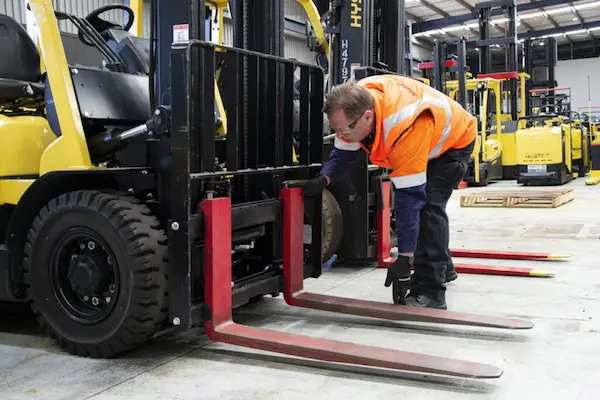
4 Architecture Pillars of an Audit-Ready Digital Inspection Workflow
Building an audit-proof daily inspection workflow requires engineering verification directly into the driver’s operational routine. Below is the structural data flow from pre-trip scan to certified audit log:
AUDIT-READY DIGITAL FLOW [NFC / QR Equipment Scan] | 1. Hardware Verification via NFC & QR Checkpoints: To eradicate pencil-whipping from breakroom tables, place high-durability NFC tags or 2D QR codes directly onto the forklift’s battery compartment and mast carriage. Operators must physically walk up and scan the tags with their mobile device to open the pre-use workflow. 2. Time-Enforced Step Workflows: Digital checklists require realistic minimum thresholds (e.g., a minimum of 180 seconds to complete 20 inspection items). The platform will reject entries submitted too quickly, forcing personnel to thoroughly inspect critical components. 3. Integrated Photographic Proof: If an operator marks a hydraulic hose as leaking or a steer tire as excessively worn, the app prompts a mandatory camera capture. The photo is automatically embedded into the maintenance work order with accurate date, time, and GPS metadata. 4. Zero-Friction Audit Exporting: When an OSHA CSHO arrives, safety directors should not spend hours rummaging through filing cabinets. Digital inspection dashboards allow administrators to filter by truck ID, date range, or shift, generating a certified PDF audit trail in seconds. |

Frequently Asked Questions
Does OSHA 1910.178 legally permit electronic or digital pre-shift forklift inspections?
Yes. OSHA standard 29 CFR 1910.178 permits electronic pre-shift inspection records provided the digital system accurately verifies the equipment condition, identifies the operator, time-stamps the entry, and provides an accessible audit trail upon request.
What happens if a forklift operator pencil-whips or skips daily pre-use inspection sheets?
Skipping or pencil-whipping inspection sheets violates OSHA regulations, exposing facilities to serious or willful penalties exceeding $161,000+ per violation, dramatically increasing workplace injury risks, and triggering severe liability in civil litigation.
How do digital inspection apps lock out a forklift if a critical safety defect is flagged?
Digital inspection apps initiate an instant lockout by notifying mechanics via SMS, placing a digital tag-out status on the vehicle profile, and, when integrated with telematics relays, remotely disabling the truck’s ignition or drive circuits.
How long must a warehouse keep historical daily forklift inspection records for OSHA audits?
EHS best practice and compliance standards dictate keeping daily forklift inspection records for at least 12 months, or indefinitely in cloud storage if an incident occurred during that operational window.
Automate Pre-Shift Inspections & Eliminate Forklift Citations
Equip your forklift fleet with SIERA.AI’s paperless digital inspections, automated impact lockouts, and real-time telematics tracking.
Explore SIERA.AI Safety Systems
→ Digital Pre-Shift Forklift Inspection Software