
Safety Analytics Navigation • Table of Contents
|
Metrics 1. Leading Indicators |
Digital Log 2. Incident Log Setup |
Comparison 3. Near Miss vs Incident |
Diagnostics 4. 5 Whys RCA |
IoT Fleet 5. Telematics Capture |
Why Leading Indicators Outweigh Lagging Metrics
Traditional warehouse safety programs evaluate success using lagging indicators: OSHA recordable rates, Days Away, Restricted, or Transferred (DART), and total worker compensation spend. These numbers only tell you how many workers got hurt after failure occurred.
Safety leading indicators reporting reverses this dynamic. Near misses provide clear signals of operational friction, workflow design flaws, and mechanical defects long before an incident occurs.
Heinrich’s Safety Triangle and updated modern safety ratios show that for every catastrophic or fatal event, hundreds of near-miss occurrences happen without physical injury. Capturing close calls provides the statistical baseline required to proactively address warehouse risks.
                  ▲
                 / \     1 Major Injury / Fatality
                /   \
               /-----\
              /   30  \   Minor Injuries / First-Aid
             /---------\
            /    300    \  Near Misses (Leading Signals)
           /-------------\
          /    3,000+     \ Unsafe Acts & Conditions
         /-----------------\
1. Setting Up a Warehouse Near Miss Incident Log
A paper-based near-miss binder on a warehouse safety board creates friction, resulting in underreported incidents and incomplete data. Modern warehousing demands digital, low-latency reporting tools.
Your digital near-miss incident log must be accessible via warehouse tablets, rugged barcode scanners, or mobile devices mounted on material-handling equipment.
Core Data Fields to Capture:
- Date, Shift, and Exact Location: Specific aisle number, rack bay, dock door, or cross-dock intersection.
- Equipment Involved: Forklift unit number, reach truck, automated guided vehicle (AGV), or manual pallet jack.
- Event Classification: Pedestrian near-impact, rack brush, unstable pallet collapse, or dropped inventory.
- Immediate Conditions: Floor surface (slick, uneven, debris), lighting, line-of-sight obstruction, or blind corners.
- Immediate Containment: On-the-spot actions taken to isolate the immediate hazard.
2. Near Miss vs. Incident: Key Differences
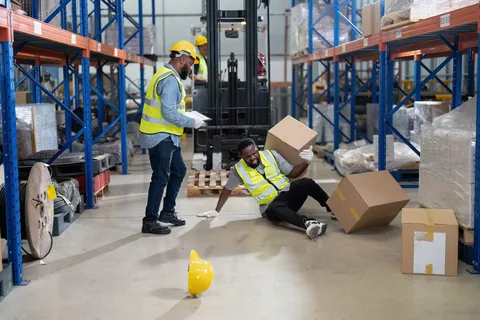
To train teams effectively, clearly delineate near misses from recordable incidents across key performance categories.
| Parameter | Near Miss | Minor Incident | Recordable Accident |
|---|---|---|---|
| Physical Harm | None; zero personal injury | Minor first-aid; no lost time | Medical treatment beyond first aid |
| Property Damage | None or minor scratch (< $50) | Moderate damage to pallet or load | Structural rack damage; vehicle breakdown |
| Indicator Type | Leading safety indicator | Transitional operational metric | Lagging regulatory metric |
| OSHA Reporting | Voluntary / Internal tracking | Internal recordkeeping | Mandatory OSHA 300 / 300A Log |
| Response Window | Logged and triaged within 24 hours | Investigated within 12 hours | Immediate halt; safety stand-down |
3. Conducting a Near Miss Root Cause Analysis
Logging an event in your incident log is only the diagnostic stage. Without systematic root-cause analysis (RCA), identical operational hazards inevitably recur.
Warehouse safety teams rely on two reliable frameworks: The 5 Whys and the Fishbone (Ishikawa) Diagram.
• Incident: A counterbalance forklift nearly struck a cycle counter walking past aisle 14.
├── Why 1: The forklift operator did not sound their horn when entering the main cross-aisle.
├── Why 2: The operator was rushing to move a pallet to staging before the shift turnover cutoff.
├── Why 3: The staging bay was backlogged with unmanifested pallets, cutting off the normal primary lane.
├── Why 4: Inbound sorting ran behind schedule due to a scanner connectivity outage.
└── Why 5 (Root Cause): The facility lacks dynamic traffic routing and mechanical pedestrian barriers at blind-spot intersections.
Addressing only the operator’s speed would miss the systemic issue. Corrective action requires physical guardrails, blue-light projection beacons, and optimized dispatch staging.
4. Operational Telematics: Automating Detection
Relying entirely on manual worker reporting creates blind spots. Modern telematics and Internet of Things (IoT) warehouse networks bridge this gap by capturing mechanical telemetry in real time.
[IoT Sensor Suite] ──► [Edge Gateway] ──► [Automated Event Log] ──► [Safety Action Task]
– Heavy Braking – Timestamp – Immediate Triage – RCA Assigned
– Sudden G-Shock – Vehicle ID – Supervisor Alert – Barrier Review
– Proximity Alarm – Floor Zone
- G-Force Shock Sensors: Automatically flag when a mast, fork, or chassis makes sudden impact with a racking upright or guardrail.
- Optical Proximity Sensors: Detect pedestrians or obstacles entering an active forklift safety halo (3–5 metres), automatically restricting drive speed.
- Steering & Velocity Telematics: Capture rapid overcorrections, sudden swerving, and harsh braking, identifying congested, high-risk aisle layouts.

Frequently Asked Questions: Near Miss Reporting
Direct answers to essential warehouse safety leadership questions:
What qualifies as a near miss in forklift operations?
Any unplanned event where a vehicle nearly struck a person, load, or rack, or experienced sudden instability, without causing injury or property damage. Examples include emergency braking to avoid a pedestrian, a tipping pallet caught mid-turn, or a fork tip glancing an empty upright.
Why is tracking near misses critical for safety leadership?
Near misses are leading indicators: statistically, dozens of close calls occur before a catastrophic, lost-time injury or fatal event happens. Tracking close calls highlights operational flaws before they turn into severe accidents or equipment losses.
How do you incentivize warehouse operators to report near misses?
Establish a non-punitive, blame-free reporting culture where reporting hazards is celebrated, simple to submit, and leads to transparent corrective action. Emphasize peer protection over blame, display closed corrective-action items during pre-shift toolbox talks, and reward proactive reporting.
Can telematics automate near-miss reporting?
Yes. Modern telemetry sensors automatically flag heavy braking, sudden swerving, shock impacts, and optical near-collision proximity events without operator input. This automated telemetry feeds your safety log directly, removing manual friction and providing objective field data.
Automate Your Warehouse Near Miss Reporting Today
Capture high-risk leading indicators automatically, eliminate blind spots, and empower operators with SIERA.AI connected safety telemetry.
Explore SIERA.AI Connected Solutions
→ Digital Pre-Shift Forklift Inspection Software (EVIR)