
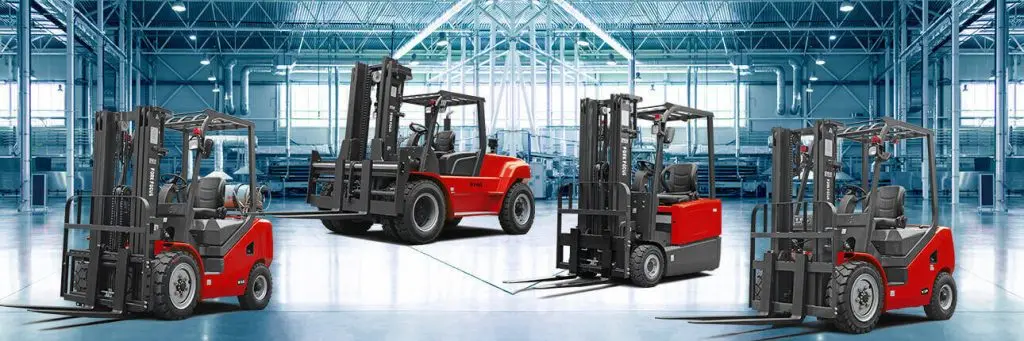
forklift technology
How forklift technology is Leading the warehouse automation Revolution in the USA
The most critical advancement is the shift from reactive sensors to Predictive AI Perception. Modern forklifts now utilize sensor fusion — combining LiDAR, 3D cameras, and 360° vision — to predict human movement up to 3 seconds before it happens, allowing safety systems to adjust speed dynamically without halting productivity.
HIGH-PRECISION FLEET
High-Precision Fleet Management for Maximum Efficiency
In the competitive logistics market, success depends on hyper-targeted precision. Modern warehouse management relies on “surgical” data points — such as exact pallet positioning and aisle-specific traffic heatmaps — to help operators eliminate specific inefficiencies. This level of precision ensures your warehouse automation isn’t just fast; it’s accurate. When every movement is calculated, the margin for error drops to near zero, increasing daily throughput.
2. Comparative Analysis
legacy vs. AI safety systems
| Feature | Legacy | AI‑Enhanced | Error Reduction | Adoption ’26 |
|---|---|---|---|---|
| Collision Avoidance | Passive Alarms | Active Braking | 92% | 74% |
| Blind Spot Detection | Convex Mirrors | 360° LiDAR + AI | 88% | 68% |
| Operator Fatigue | Manual Monitoring | Biometric Tracking | 70% | 55% |
| Pallet Placement | Human Eyesight | Fork‑Tip Guidance | 95% | 81% |
The Shift to Autonomous Logistics in the USA
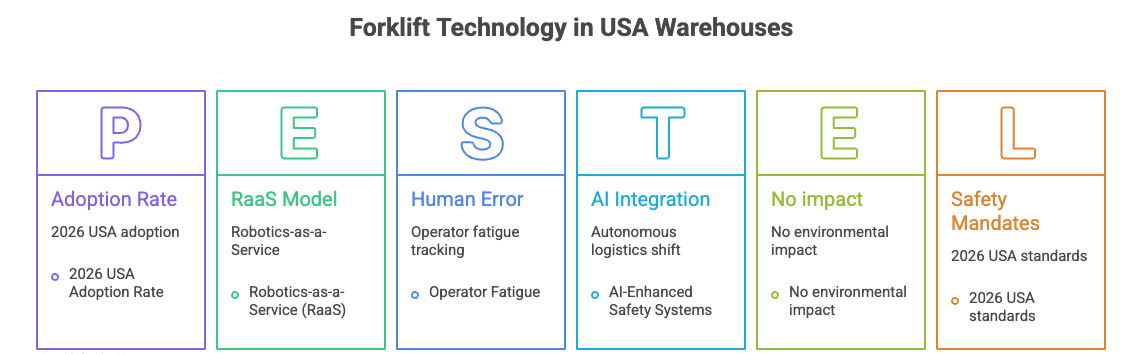
The current trend in the United States shows a massive pivot toward Robotics-as-a-Service (RaaS). This allows facilities to implement warehouse automation as an operational expense rather than a massive upfront capital hit. By integrating forklift technology that communicates directly with the warehouse management system (WMS), companies achieve a seamless flow. This connectivity is the backbone of modern facility optimization, where the system knows the location, status, and maintenance needs of every asset in real-time.
USA Industry FAQs
top services & safety mandates