
Reduce Accidents, Ensure OSHA Compliance, and Leverage AI Automation
Warehouse operations are moving faster than ever. Driven by rapid e-commerce expansion and intense high-throughput demands, over 4.7 million warehouse robots and 750,000 active forklifts are navigating modern fulfillment hubs across the United States. However, this massive operational scale comes with a steep price: OSHA estimates that 10% of all workplace fatalities in the U.S. are related to forklift accidents, resulting in approximately 85 fatalities and 34,900 serious injuries annually.
For warehouse managers, safety is no longer just about handing out a manual or checking a compliance box. The operational landscape has completely shifted from reactive incident tracking to proactive, data-driven accident prevention. Breakthrough technologies like AI-powered monitoring systems are now dropping accident rates by up to 35%, helping fleet operators stay ahead of strict OSHA forklift compliance mandates, and lowering total cost of ownership (TCO).
This in-depth guide covers everything you need to know about compliance updates, advanced industrial telemetry, and how to build a highly optimized, human-centric warehouse safety culture.
Under the federal standard 29 CFR 1910.178, OSHA’s regulatory framework focuses heavily on active risk management. Compliance audits no longer stop at validating paper documentation; auditors actively look for structured, technology-assisted training verification and documented behavioral intervention protocols.
OSHA’s current enforcement agenda targets high-risk sectors like manufacturing, construction, and supply chain logistics with expanded, unannounced inspections. When compliance officers evaluate a facility’s powered industrial trucks (PIT) program, they focus heavily on three major pillars:
- 1910.178(l) Operator Training & Evaluation: Employers must provide a structured training program combining formal instruction (safety rules, stability physics), practical hands-on exercises, and a definitive on-site workplace evaluation. While a full retraining isn’t legally required every three years, employers must conduct a formal triennial performance evaluation to confirm ongoing competency.
- Behavioral Monitoring & Intervention: If an operator is observed handling a truck unsafely, experiences a near-miss, or is involved in a collision, mandatory refresher training must be triggered instantly.
- 1910.178(p) & (q) Strict Inspection and Maintenance: Daily pre-operational checks are a hard legal mandate. Any forklift found with an operational defect—such as a torn seatbelt, leaking hydraulic line, or a weak horn—must be tagged out of service immediately until authorized repairs are completed.
The financial stakes of ignoring these updates continue to climb. A single unaddressed violation can severely impact an industrial operation’s bottom line:
- Serious Violations: Fines start at $15,625 per individual incident.
- Willful or Repeat Violations: Fines skyrocket up to $156,259 per violation.
Beyond these federal penalties, facilities lagging in modern safety tech face climbing worker’s compensation claims, legal civil litigation, and severe insurance premium spikes. Proactive fleet managers use advanced safety solutions to exceed minimum regulatory guidelines, establishing a robust buffer during inspections while protecting their operators. Learn more about optimizing your internal audit readiness by reviewing the core forklift safety system technical specifications.
To meet these strict standards, the industrial sector is replacing legacy processes with advanced hardware and data intelligence. Modern forklift safety technology trends are centered around a single goal: eliminating human error caused by cognitive overload, fatigue, and environmental blind spots.
Traditional backup cameras rely entirely on the operator’s attention. In contrast, modern AI-driven camera systems act as a continuous, 360-degree digital copilot. High-definition edge cameras capture the vehicle’s surrounding environment, while onboard computer vision models process the video feed frame by frame.
When the system detects a pedestrian, a worker in a blind spot, or an obstacle, it instantly highlights the hazard with a colored box on the cabin display and sounds a localized alarm. Because AI doesn’t experience mental fatigue, it actively reduces the operator’s cognitive load in chaotic, noisy distribution hubs. Discover how these vision algorithms function in real time by reading about pedestrian detection and forklift AI.
Relying solely on auditory backup alarms like beepers can lead to sensory desensitization in a loud warehouse. Advanced proximity detection systems use Ultra-Wideband (UWB) radio frequencies, RFID tags, or magnetic fields to form invisible safety perimeters around moving machinery.
Pedestrians, supervisors, and visiting delivery drivers wear small, lightweight tags on their high-visibility vests or hard hats. If a worker steps into a pre-configured warning zone, the forklift’s console triggers an immediate alert. If they breach the inner danger zone, the system can interface directly with the forklift’s electronic throttle control to safely slow down or stop the machine before an impact occurs. For a deeper look at setting up these safety zones, see our comprehensive guide on forklift pedestrian safety systems.
Modern telemetry networks have shifted fleet management from reactive repairs to predictive maintenance. Integrated sensors throughout the vehicle chassis continuously record critical operational metrics:
- Curve Speed Control: Automatically drops travel speeds when executing sharp turns to eliminate tip-over risks.
- Load Moment Indicators: Measures total weight and center of gravity in real time, locking out the lift mechanism if the operator attempts to carry an unsafe or unbalanced load.
- Impact Sensing: Registers the exact G-force, timestamp, and operator ID of any collision or harsh braking incident, feeding the data directly to a centralized cloud dashboard for supervisor review.
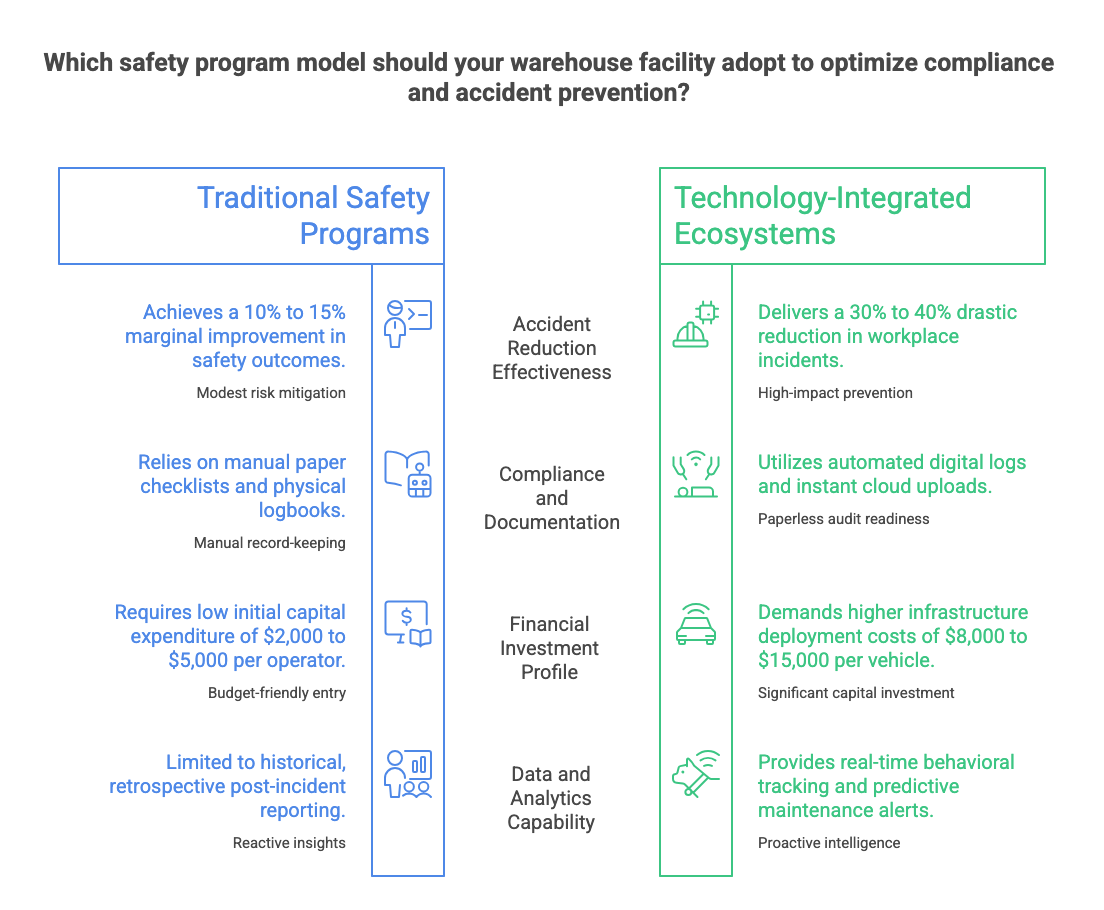
Many warehouse operators wonder whether the capital investment required for high-tech telemetry is justified compared to traditional safety methods. The empirical data from modern industrial implementations reveals a clear difference in return on investment (ROI), asset protection, and accident reduction.
Conventional safety procedures compare directly against modern, tech-enabled safety ecosystems across key operational metrics. While traditional methods provide a baseline for compliance in small operations, they fail to prevent severe incidents in high-velocity environments. Technology-integrated setups give supervisors the granular data required to identify unsafe habits before they lead to an injury or equipment damage. To track, visualize, and benchmark these data points, check out our centralized metrics and analytics platform.
The evolution of warehouse automation has drastically changed the way forklift operators are onboarded and certified. With the growing integration of automated guided vehicles (AGVs) and complex warehouse layouts, training programs must be equally dynamic.
Rather than training a novice operator on a live, multi-ton machine in a crowded aisle, modern certification programs utilize AR headsets. Trainees step into an immersive, digital workspace where interactive hazards—such as unexpected pedestrians crossing an aisle or falling pallet loads—are safely simulated.
This environment allows operators to build deep muscle memory, master spatial awareness, and practice complex maneuvers like high-tier stacking without any physical risk to themselves, the facility infrastructure, or nearby staff. Studies show that AR-enhanced training models compress total onboarding times by up to 25% while yielding substantially higher skill-retention scores. For actionable advice on blending these training modules with traditional onboarding, read our expert insights on forklift safety.
Safety training is no longer a “one-and-done” event. Once an operator completes their initial certification, their daily operational habits are constantly tracked by integrated telematics systems. If an operator frequently triggers warning thresholds for hard cornering or aggressive braking, this behavior is logged onto a supervisor dashboard.
Instead of general, broad safety meetings, managers can deliver personalized, data-backed coaching sessions addressing the specific operational habits of individual drivers. This continuous feedback loop ensures that complacency doesn’t set in, keeping long-term accident rates to an absolute minimum.
Even with clear data supporting modern safety technology, several persistent misconceptions continue to impact warehouse operations. Addressing these myths helps teams make informed decisions about their facility layouts and training strategies.
- Myth 1: Inexperience is the root cause of almost all forklift collisions.
The Reality: Comprehensive accident investigations show that fatigue, distraction, and workplace stress contribute to over 40% of warehouse forklift incidents, regardless of how many years an operator has been certified. Experienced drivers often become overly comfortable, leading them to bypass standard pre-checks, speed in designated zones, or turn with an elevated mast—risks that a newer, more cautious operator rarely takes. Learn more about mapping these behavioral trends via our dedicated resources on forklift pedestrian safety. - Myth 2: AI monitoring and automation are designed to replace human supervisors.
The Reality: Technology is a tool for empowerment, not a replacement for human leadership. An AI camera or a telemetry sensor can flag an unsafe behavior, track a pattern, or provide an alert, but it cannot step into the cabin to mentor an employee, understand workplace context, or build a strong team safety culture. The most effective operations pair automated detection networks with empathetic, structured human leadership. - Myth 3: Advanced proximity and telemetry systems violate operator privacy.
The Reality: Well-engineered fleet safety systems are strictly designed to track industrial vehicle dynamics and identify high-risk behavioral anomalies (such as high travel speeds or collision impacts). They do not track personal conversations or activities. When operators are included in the onboarding process and see that the data is used to protect them from pedestrian collisions, implementation friction drops significantly.
Transitioning a busy distribution center or manufacturing floor to an AI-assisted, tech-driven safety ecosystem requires a structured, phase-by-phase implementation plan to prevent operational downtime.
- Phase 1: Comprehensive Gap Analysis
Evaluate your facility’s current baseline against OSHA forklift compliance rules. Document your active blind spots, narrow aisle high-traffic zones, and record any historic fleet maintenance bottlenecks. - Phase 2: Pilot Sensor Calibration
Deploy edge-AI camera hardware and warning tags onto a controlled baseline of 2 to 5 industrial vehicles. Run this gear across your highest-throughput shift for 30 days to clear out false-positive alarms and establish baseline driver safety scores. - Phase 3: Operator and Supervisor Alignment
Introduce the software dashboard insights to your shift leaders. Ensure the team understands that real-time tracking metrics are built for data-driven coaching and structural hazard removal, rather than punitive actions. Explore specialized mitigation plans for these zones in our guide on forklift and pedestrian safety. - Phase 4: Full-Fleet Deployment
Integrate telemetry, speed zone controllers, and impact tracking across your remaining powered industrial trucks. Transition your daily physical logs into paperless, cloud-saved mobile preshift forklift checks to stay audit-ready at all times. - Phase 5: Continuous Optimization Loops
Audit your data analytics metrics monthly. Adjust your warehouse floor layout markings, optimize rack placements based on high-frequency proximity warnings, and publicly reward your top-scoring drivers to maintain an active safety culture.
A: According to industrial accident data, 42% of forklift fatalities are caused by the operator being crushed during a vehicle tip-over, making it the single most common fatal mechanism. Many of these fatal outcomes occur because the driver was not wearing a seatbelt and was thrown or tried to jump from the cabin during the tip-over, landing directly under the falling overhead guard (a pattern known as “mousetrapping”). Additionally, 43% of reported incidents involve an impact with a third party, the vast majority being pedestrians performing completely unrelated tasks nearby.
A: Yes. Forklift stability physics and collision forces do not change based on the square footage of a building. In fact, a single severe forklift accident or a willful OSHA fine can be financially devastating for a growing business, whereas a larger enterprise might absorb the cost more easily. Scalable telemetry, digital checklists, and AI camera solutions are readily available to fit smaller fleet footprints.
A: Facilities must focus heavily on visual segregation and automated hardware override protocols. Installing physical barriers, heavy-duty guardrails, and distinct floor coatings helps keep walking paths separate from heavy equipment. To eliminate human reaction delays entirely, implement an active forklift pedestrian collision avoidance system that automatically reduces vehicle speed when a worker breaches a designated safety buffer.
Achieving consistent OSHA forklift compliance while maintaining high throughput demands a modern approach to warehouse fleet safety. Merely tracking incidents after they happen is no longer sufficient; operations must actively prevent them. By integrating advanced machine vision, proximity tracking, and continuous data coaching, fleet operators can significantly lower accident rates, protect their workforce, and improve long-term profitability.
Ready to see how intelligent telemetry can transform your facility? Explore our complete breakdown of cutting-edge industrial technology, deployment strategies, and warehouse optimization frameworks on our main SIERA.AI Blog.