

|
AI Computer Vision vs. RFID Tag Solutions
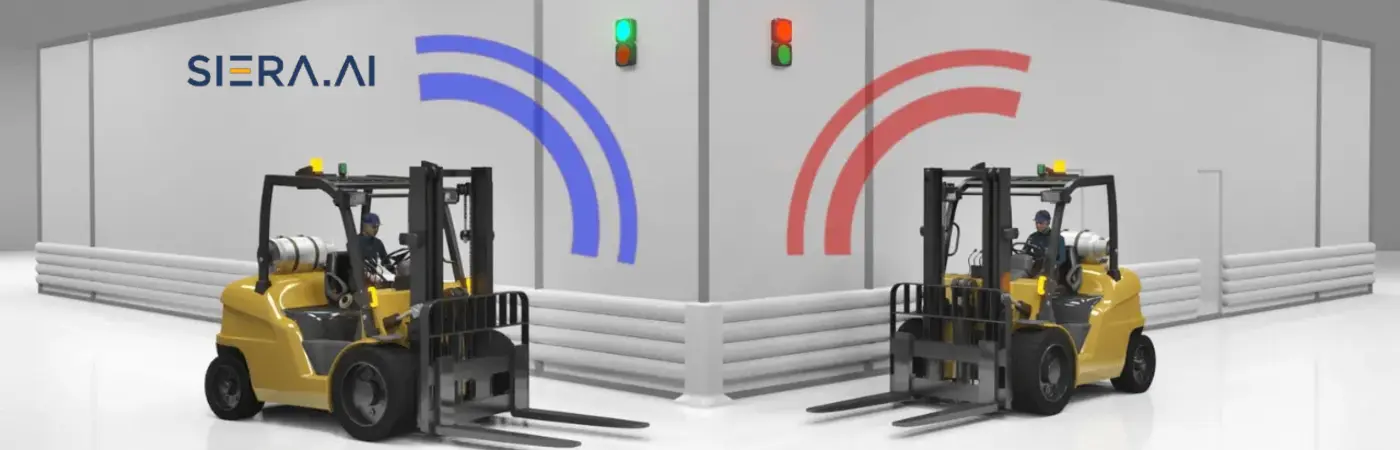
A forklift pedestrian detection system monitors blind spots and travel paths around material handling equipment to warn operators of nearby personnel and prevent collisions. While legacy solutions depend on wearable RFID badges, modern industrial facilities use AI computer vision cameras that actively recognize human shapes in real time without requiring pedestrians to wear tags.
Forklifts account for roughly 35,000 serious injuries and 85 fatal workplace incidents every year in the United States, according to OSHA estimates. Over 36% of these incidents involve pedestrians struck, crushed, or pinned by moving equipment. Selecting the right proximity detection technology is one of the most critical safety investments an EHS director, facility manager, or VP of Operations will make. |
Understanding the Technologies: How They Work
Proximity detection technologies differ fundamentally in how they identify human life in an industrial aisle:
|
AI Computer Vision Systems (Camera-Based) High-definition, industrial-grade cameras mounted on the front, rear, or mast of the forklift feed continuous optical frames to an on-board edge AI processor. Neural networks analyze each frame in milliseconds to detect human anatomical silhouettes, distinguishing a walking or crouching human from pallets, racking, and support columns. |
RFID Proximity Systems (Sensor & Tag-Based) Electromagnetic antennas mounted on the forklift broadcast radio waves across a defined perimeter. When a pedestrian wearing an active or passive RFID badge steps within that radio field, the tag reflects the signal back to the receiver, triggering an in-cab buzzer or strobe light. |
Feature Comparison: AI Computer Vision vs. RFID Tags
| Feature / Metric | AI Computer Vision (e.g., SIERA.AI S3) | RFID Tag Solutions |
|---|---|---|
| Detection Method | Real-time neural network optical tracking | RF electromagnetic field transceivers |
| Pedestrian Requirement | Zero requirements (identifies any person) | Must wear active, fully charged RFID badge |
| Visitor / Vendor Protection | Immediate and 100% active | Zero protection unless assigned a guest tag |
| False Alarm Rate | Low (filters stationary walls and racking) | High (alarms trigger through racking & drywall) |
| Hardware Costs | $2,200 – $4,500 per lift truck | $1,200 – $2,500 per truck + $45–$120/badge |
| Maintenance Burden | Lens cleaning during pre-shift inspection | Battery replacement, tag tracking, tag audits |
| Nuisance Beeping | Targeted to directional pedestrian hazards | High (tag alerts through walls cause alarm fatigue) |
| Data & Near-Miss Logs | Cloud analytics with time-stamped footage | Signal count logs without visual verification |
The Operational Breakdown: Where Each System Wins and Fails
|
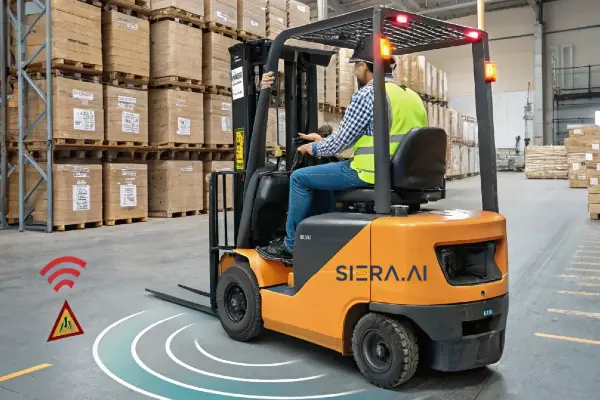
1. The Human Compliance DilemmaRFID tag systems only work when human execution is flawless. If a picker forgets their badge, leaves it on a charging rack, wears a dead battery, or if an outside freight driver steps onto the dock, the RFID system provides zero collision prevention. AI computer vision removes human error from the equation. The system protects warehouse employees, third-party contractors, temporary workers, and office personnel whether they are wearing protective gear or standard work clothes. 2. Nuisance Alarms and Sensor Blind SpotsA major operational drawback of RFID is non-directional penetration. Radio waves pass through pallet racking, cardboard, and light drywall partitions. An operator driving down Aisle 4 may receive persistent proximity alarm warnings from an order picker working safely in Aisle 5 behind solid racking. This creates alarm fatigue, prompting operators to ignore or tamper with the alerts. AI optical cameras focus strictly on the direct path of travel and adjacent operational blind spots. They differentiate between an immovable steel beam and a human moving into a hazardous area. 3. Total Cost of Ownership (TCO)While RFID hardware for the forklift itself often presents a lower initial entry price, managing badges across facilities with 100+ employees creates ongoing friction. Battery replenishments, lost badge replacements, and administrative labor drive up lifetime costs. AI cameras feature self-contained edge processing, avoiding ongoing peripheral badge procurement and deployment overhead. |
Proactive Risk Elimination in Busy AislesIn active logistics hubs, seconds determine the difference between a safe stop and an OSHA recordable incident. Machine-vision pedestrian systems operate within low-latency thresholds, giving drivers proactive alerts before pedestrians step into direct vehicle trajectory. By coupling directional alerts with continuous telemetry logging, safety managers gain visibility into high-frequency near-miss choke points across their facility layout. |
Safety Impact Benchmarks 0 Required
Wearable badges or tags for pedestrians
< 30 ms
Edge AI human recognition latency
36%
Forklift incidents involving pedestrian impacts
|
Top 5 Search FAQs: Forklift Pedestrian Detection
1. What is the most reliable forklift pedestrian detection system for busy warehouses?
AI computer vision systems provide the highest operational reliability for busy distribution hubs because they identify any pedestrian automatically without relying on wearable hardware or active tags. Systems like the SIERA.AI S3 Safety System pair optical pedestrian recognition with real-time audio-visual alerts and automatic incident logging, reducing human compliance failure points.
2. How does AI computer vision compare to RFID wearable badge systems for pedestrian alerts?
AI computer vision uses cameras and deep-learning edge processors to visually identify human anatomy, providing targeted warnings only when a person enters a hazard zone. In contrast, RFID systems require every person on the floor to carry an active tag. RFID signals also pass through walls and racking, leading to high rates of nuisance alarms and operator fatigue.
3. Do RFID pedestrian warning tags suffer from false alarms and sensor blind spots?
Yes. RFID signals travel indiscriminately through solid warehouse objects, triggering in-cab alarms when pedestrians are working safely in adjacent aisles. Additionally, if an RFID badge is covered by heavy materials or the pedestrian enters the facility without their tag, the sensor fails to register their presence, creating severe blind spots.
4. What is the average cost to equip an industrial forklift fleet with AI proximity sensors?
Equipping an industrial forklift fleet with AI pedestrian detection cameras typically ranges from $2,200 to $4,500 per vehicle, depending on single vs. dual-camera coverage, dynamic speed-governing integrations, and cloud analytics features. Unlike RFID, there are no recurring costs for worker badges or sensor batteries.
5. How does active pedestrian detection reduce OSHA recordable workplace incidents?
Active pedestrian detection lowers OSHA recordables by replacing operator reaction time with predictive, sub-second collision warnings. Systems equipped with telemetry automatically record near-misses on a centralized dashboard, allowing EHS teams to identify crosswalk safety hazards, coach high-risk drivers, and proactively prevent violations under OSHA standard 29 CFR 1910.178.
Prevent Pedestrian Collisions Before They Happen
Discover how SIERA.AI’s machine-vision cameras actively protect workers, contractors, and visitors without wearable tags.
Explore Related Solutions
→ S2 & S3 Pedestrian Detection Safety Systems
About the Author
Ram Kumar, Chief Executive Officer at SIERA.AI, has spent 10 years working with forklift dealerships on fleet studies, service department workflows, and telematics rollouts. Connect on LinkedIn.