
|
Real-Time Shock Analytics Before Collisions Escalate: A forklift impact detection system uses multi-axis telemetry shock sensors to record G-force thresholds, automatically flagging structural bumps, sudden decelerations, and micro-collisions in real time. Connected to warehouse near miss reporting software, it isolates high-risk zones, prevents catastrophic rack collapses, and automates operator accountability before minor incidents turn into OSHA recordables.
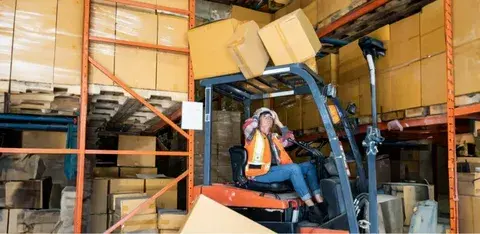
Why Micro-Impacts Signal Impending Warehouse CatastrophesIn high-throughput distribution hubs, catastrophic rack collapses and severe pedestrian strikes rarely occur without warning. They are almost always preceded by dozens of unrecorded micro-impacts—low-speed bumps, clipped pallet uprights, and abrupt directional reversals. |
Traditional reporting fails here because manual incident logging relies on self-reporting, creating a blind spot around minor collisions. By the time visual upright deflection is noticeable during a safety walk, rack integrity may already be critically compromised.
Integrating real-time shock analytics shifts warehouse safety management from lagging post-mortem reviews to automated, proactive prevention.
How Telemetry Shock Sensors Capture Near Misses
Modern industrial vehicles utilize tri-axial accelerometers integrated directly into the vehicle’s controller area network (CAN bus) or as standalone IoT telemetry units. These sensors evaluate dynamic forces across three distinct planes:
|
X-Axis (Longitudinal) Measures harsh braking, abrupt acceleration, and head-on/rear impacts. |
Y-Axis (Lateral) Flags sharp cornering, tipping hazards, and side-swipes against guardrails or structural columns. |
Z-Axis (Vertical) Tracks extreme floor anomalies, dock plate drop-offs, and high-speed transit over uneven expansion joints. |
When dynamic G-force thresholds exceed calibrated limits, the telemetry node instantly transmits an event payload containing the exact force magnitude, vehicle ID, operator badge details, timestamp, and facility coordinates.
│
▼
[Edge Telemetry Filter (Eliminates Pothole Noise)]
│
▼
[Cellular/Wi-Fi Transmission to Cloud Platform]
├─► Vehicle Controller: Automatic “Crawl Mode” Lockout
├─► Fleet Manager: SMS/Email Alert with Impact Telemetry
└─► Safety Software: Auto-Populated Near-Miss Record
Impact Analytics vs. Manual Near-Miss Reporting
Automating shock detection bridges the gap between physical vehicle handling and central safety compliance software.
| Metric / Capability | Legacy Manual Logging | Telemetry Impact Detection + Software |
|---|---|---|
| Detection Speed | Hours to days (if reported at all) | Sub-second (<500ms) instant alert |
| Data Objectivity | Subjective operator estimate | Calibrated G-force vector & velocity data |
| Near-Miss Capture Rate | Estimated <15% capture rate | 100% of threshold breaches logged |
| Post-Incident Action | Delayed inspection | Automated vehicle lockout / crawl-speed trigger |
| OSHA/ISO Audit Trail | Paper logs, prone to gaps | Immutable, timestamped digital logs |
| Rack Damage Attribution | Unknown point-of-impact | Exact operator, vehicle, and time mapped |
Calibrating G-Force Thresholds: Filtering False Positives
A common pitfall in deploying impact detection systems is alert fatigue caused by false positives. Driving across a standard dock leveler or over a damaged expansion joint should not trigger a high-severity collision alarm.
Effective shock analytics platforms implement dual-tier thresholds:
|
1. Low-Severity / Operational Events (0.5G – 1.2G) These indicate aggressive vehicle operation, such as rapid braking or speeding over dock transitions. They are logged as behavioral near misses in the warehouse reporting software to identify operators who require coaching, without locking down the equipment. 2. High-Severity Critical Impacts (>1.5G – 3.0G+) These events indicate a physical collision with structural racking, building infrastructure, or another vehicle. The system triggers immediate visual and audible alarms on the truck, drops the machine into restricted limp mode, and dispatches a prioritized inspection ticket to maintenance supervisors. |
Integrating Impact Telemetry with Safety Workflows
Capturing raw telemetry is only half the battle; closing the loop through automated workflows is what drives down incident rates.
|
Immediate Equipment Interlock High-impact collisions automatically lock out the vehicle’s drive unit, requiring a supervisor or safety manager’s key card/digital authorization to restore operation following a physical inspection. Automated Near-Miss Docket Creation Rather than requiring safety officers to manually draft incident forms, the event automatically generates a pre-populated near-miss ticket with telemetry graphs, driver verification, and equipment runtime data. Facility Heat Mapping Aggregating low-level shock events across fleet units highlights facility choke points, blind intersections, or floor degradation that consistently generate near-miss forces. |
Impact Benchmarks < 500 ms
Instant alert transmission speed
60% – 80%
Drop in impacts within 90 days
100%
Near-miss threshold breaches logged
|
Frequently Asked Questions
How does a forklift impact detection system differentiate between a real collision and driving over a dock plate?
Advanced telemetry sensors analyze both force magnitude and pulse duration. Dock plate crossings generate high-frequency, short-duration vertical vibrations (Z-axis), whereas structural collisions generate sustained longitudinal or lateral force profiles (X/Y-axis) that the system’s firmware separates automatically.
Can impact detection software be retrofitted to mixed forklift fleets?
Yes. Modern IoT telemetry gateways operate independently of vehicle drive systems and can be retrofitted onto electric, diesel, and LPG forklifts across diverse brands and model years.
How does automated near-miss reporting affect operator accountability?
Because login requires RFID or digital badge authentication, every shock metric is tied to the active operator. Facilities shifting to automated reporting typically experience a 60% to 80% decrease in overall fleet impacts within the first 90 days due to heightened operational awareness.
Ready to Prevent Impact Escalation?
See how real-time shock analytics and automated near-miss reporting protect your fleet, racking, and facility.
Explore Related Solutions
→ Fleet Telematics & Impact Monitoring
About the Author
Ram Kumar, Chief Executive Officer at SIERA.AI, has spent 10 years working with forklift dealerships on fleet studies, service department workflows, and telematics rollouts. Connect on LinkedIn.