

Compliance Navigation • Table of Contents
|
Statutes 1. OSHA 1910.178 |
Inspection 2. Safety Audits |
Design 3. ANSI B56 Codes |
Enforcement 4. 2026 Penalties |
Protocols 5. Daily Checklists |
Powered industrial trucks (PITs) consistently rank among OSHA’s top 10 most frequently cited workplace safety violations. For operations directors, EHS leaders, and plant managers, compliance is an active operational discipline that prevents catastrophic liability and shields balance sheets from aggressive enforcement penalties.
1. US Forklift Safety Regulations (29 CFR 1910.178)
Federal OSHA oversees powered industrial truck operations primarily under general industry standard 29 CFR 1910.178 (with corresponding mandates under 29 CFR 1926.602 for construction). These regulations govern safe machine manufacture, operator licensing, and ongoing maintenance cycles.
Operator Training & Certification (1910.178(l)): Employers must verify that every driver has completed formal instruction, practical hands-on training, and an on-site evaluation. Refresher training is mandatory every three years, or immediately following an accident, near-miss, or observed unsafe operation.
Pre-Shift Inspections (1910.178(q)(7)): Industrial trucks must be examined before being placed in service. In continuous multi-shift operations, evaluations must occur prior to the start of each individual shift.
Maintenance & Tag-Out (1910.178(p)(1)): Any truck showing mechanical defects, hydraulic leaks, steering play, or horn/brake failure must be taken out of service immediately until restored to safe operating condition by authorized personnel.
Beyond specific line items, OSHA enforces mandatory operator restraint usage under the General Duty Clause (Section 5(a)(1)). When a lift truck is equipped with a seatbelt or manufacturer-installed restraint, operators are legally required to wear it to prevent crushing fatalities during lateral tip-over events.
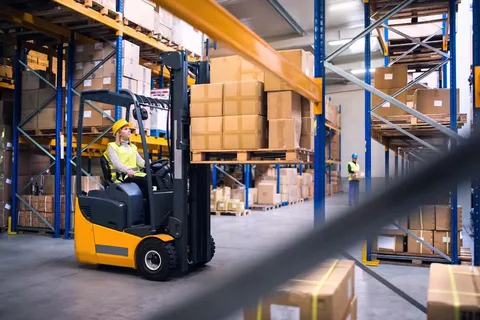
2. The Core Safety Compliance Audit: What Inspectors Look For
An internal audit ensures your facility stays inspection-ready before a Compliance Safety and Health Officer (CSHO) arrives unannounced. Audits systematically investigate four core operational domains:
Forklift Audit Focus:
├── Documentation ──► Training records, certifications, pre-shift logs
├── Equipment ──► Horns, backup alarms, tires, forks, hydraulic systems
├── Environment ──► Floor markings, pedestrian separation, dock plates
└── Operator Ops ──► Speed enforcement, seatbelt use, staging protocols
During an audit, inspectors cross-reference daily inspection logs with equipment hour meters. When pre-shift forms are uniformly signed without a single defect while trucks on the floor have worn tires, hydraulic seepage, or non-functioning warning beacons, inspectors classify the documentation as systemic record falsification or willful non-compliance.
3. ANSI/ITSDF B56 Standards & Equipment Governance
While OSHA establishes enforceable federal law, equipment manufacturing baselines, stability tests, and technical criteria stem from consensus standards published by the Industrial Truck Standards Development Foundation (ITSDF) under the American National Standards Institute (ANSI).
- ANSI/ITSDF B56.1: Safety Standard for Low Lift and High Lift Trucks (covers operator guardrails, stability testing, braking requirements, and operational controls).
- ANSI/ITSDF B56.5: Safety Standard for Guided Industrial Vehicles and Automated Functions of Manned Industrial Vehicles.
- ANSI/ITSDF B56.6: Safety Standard for Rough Terrain Forklift Trucks.
Under 29 CFR 1910.178(a)(4), modifications or additions affecting truck capacity or safe operation cannot be made without prior written approval from the original equipment manufacturer (OEM) or a certified professional engineer. Installing third-party attachments without updated data plates calculating derated capacities invalidates compliance immediately.
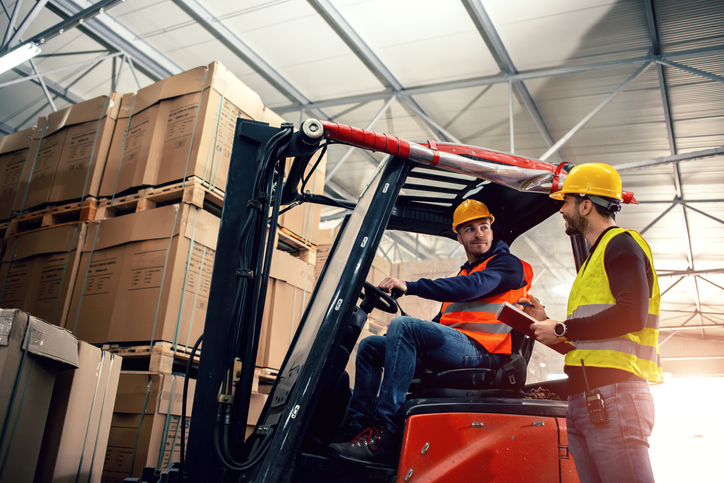
4. OSHA Civil Penalty Structure (2026 Adjusted Rates)
Under the Federal Civil Penalties Inflation Adjustment Act, statutory fine maximums increase annually. Non-compliance carries severe financial consequences:
| Violation Category | Maximum Statutory Fine (2026) | Typical Violation Trigger |
|---|---|---|
| Serious Violation | $16,550 per violation | Operating an uninspected forklift with worn brakes or failing horn. |
| Other-Than-Serious | $16,550 per violation | Missing certification records or incomplete daily inspection sheets. |
| Repeat Violation | $165,514 per violation | Substantially similar safety violation identified within the preceding 5 years. |
| Willful Violation | $165,514 per violation | Allowing uncertified drivers to operate machinery with intentional disregard. |
| Failure to Abate | $16,550 per day | Failure to correct an identified hazard beyond the assigned OSHA abatement deadline. |
*Note: In OSHA State Plan jurisdictions (e.g., Cal/OSHA, MIOSHA), state enforcement agencies can assess supplemental fines that match or exceed federal penalty tiers.
5. Daily Inspection Protocol: Paper vs. Digital Logs
Pre-operational equipment checklists can be completed on physical log sheets or through cloud-connected mobile telematics. OSHA does not mandate a specific storage medium, provided employers maintain documented, auditable proof that every vehicle check was completed before operational use.
┌───────────────────────────────────────────────────────────────┐
│ PRE-SHIFT INSPECTION CHECKPOINT │
├───────────────────────────────┬───────────────────────────────┤
│ Operational Check │ Visual / Mechanical Check │
├───────────────────────────────┼───────────────────────────────┤
│ • Accelerator & service brake │ • Fluid leaks (oil/hydraulic) │
│ • Forward/reverse steering │ • Tire condition & pressure │
│ • Horn & warning beacons │ • Fork integrity & lock pins │
│ • Mast lift, tilt, & extend │ • Data plate readability │
│ • Seatbelt latching mechanism │ • Battery cable / LPG bracket │
└───────────────────────────────┴───────────────────────────────┘
Facilities transitioning to electronic vehicle inspection reports (EVIR) significantly streamline audit preparation. By mounting interactive digital tablets directly to the truck, ignition access is locked until the operator successfully completes each step. Any safety failure automatically tags the machine out in real time, notifying maintenance instantly.
Frequently Asked Questions: US Forklift Compliance
Direct answers to essential regulatory, legal, and operational audit questions:
Who regulates industrial forklift safety in the United States?
Forklift safety and operational compliance are primarily enforced by the Occupational Safety and Health Administration (OSHA) under 29 CFR 1910.178, alongside state-level OSHA programs. Equipment manufacturing and design benchmarks are governed by consensus standards from ANSI and the Industrial Truck Standards Development Foundation (ITSDF B56 series).
What happens during an OSHA forklift compliance audit?
An OSHA compliance officer evaluates written operator certification files, inspects daily pre-operational logs, assesses pedestrian walkway barricades and traffic controls, and conducts hands-on physical inspections of in-service lift trucks to verify brake, horn, fork, and seatbelt integrity.
Are safety seatbelts mandatory on forklifts in the US?
Yes. OSHA requires forklift operators to wear installed seatbelts and operator restraint devices. Enforced under the General Duty Clause (Section 5(a)(1) of the OSH Act), failure to wear seatbelts exposes companies to serious citations because restraints protect operators from crushing injuries during lateral tip-overs.
What are the financial penalties for non-compliant forklift operations?
Federal OSHA penalties can reach up to $16,550 per serious or other-than-serious violation and escalate to $165,514 per willful or repeat violation. Cumulative daily fines of up to $16,550 can also be assessed for each day an employer fails to abate an identified hazard.
Does the US require digital records for forklift inspections?
No, OSHA permits both written paper checklists and digital inspection systems. However, logs must document the operator’s identity, timestamp, equipment ID, inspection results, and immediate lockout/tagout actions if defective equipment is identified.
Automate Your OSHA Forklift Compliance Today
Eliminate paperwork, ensure 100% pre-shift inspection completion, and protect your operators with SIERA.AI intelligent safety systems.
Explore SIERA.AI Connected Solutions
→ Digital Pre-Shift Forklift Inspection Software (EVIR)