

|
Quick answer: Preventing peak season forklift accidents comes down to four controls working together — strict pedestrian-equipment separation, mandatory site-specific onboarding for every temporary operator, proactive daily equipment inspections, and enforced speed limits, backed by structured traffic management and collision-avoidance technology.
During Q3 and Q4 fulfillment surges, retail distribution centers and 3PL providers face intense throughput demands. Rapid hiring cycles bring in temporary forklift operators who may hold a valid license but have never seen the facility’s layout, blind spots, or traffic patterns — and that gap is where most surge-season incidents start. |
When high-density floor traffic meets compressed delivery windows, the margin for error shrinks fast. Below is the full picture: where surge-season accidents actually happen, the controls that measurably reduce them, and the three core protocols every facility should have in place before peak volume hits.
The Peak Season Safety Challenge
Three pressures compound at once during surge periods — and any one of them alone is manageable. Together, they’re where accidents come from.
|
Inexperience Seasonal drivers unfamiliar with the facility’s specific layout, rack heights, and blind corners. |
Congestion Staging areas and loading docks packed tighter as inbound and outbound volume both spike. |
Fatigue Extended shifts and overtime pressure eroding reaction time late in a run of long days. |
High-Risk Areas in Retail Distribution Centers
Surge-period incidents cluster in a handful of predictable spots — which means they’re also the easiest places to engineer risk out of.
|
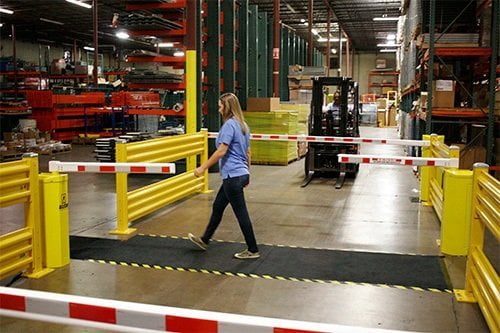
Loading Docks & Charging Stations Unscheduled trailer pullaways, dock drop-offs, staging bottlenecks · congestion during rapid battery-swap and shift handoffs Aisle Intersections & Crosswalks Limited visibility behind high-bay racking and stacked seasonal inventory · heavy seasonal-picker foot traffic crossing main travel paths |
High-Volume Safety Controls
Each risk factor has a specific root cause — and a specific, measurable intervention that closes the gap.
| Risk Factor | Root Cause | Safety Intervention | Measurable KPI |
|---|---|---|---|
| Temporary Driver Error | Unfamiliarity with layout | 4-hour site orientation and floor shadowing | 100% sign-off before unassisted floor access |
| Pedestrian Strikes | Shared traffic paths | Guardrails, blue LED spotlights, designated walkways | Zero near-miss pedestrian events per shift |
| Dock Accidents | Premature trailer departure | Interlocked restraints and red/green dock lights | 100% dock restraint engagement rate |
| Operator Fatigue | Overtime and surge pressure | Scheduled rotation cycles and enforced rest intervals | Zero fatigue-related telematics warnings |
| Overall Peak Season Readiness | Engineered, not left to individual judgment | ||
Core Protocols for Surge Operations
Three protocols form the backbone of peak season floor safety. None of them require new headcount — just structure.
|
1. Site-Specific Onboarding for Seasonal Drivers Never deploy temporary operators straight onto the floor. Even experienced drivers need a structured walkthrough of facility-specific rules before their first unassisted shift. Enforce posted speed limits (typically 5 mph indoors, 3 mph at intersections) · review rack heights, narrow-aisle clearance, and load center capacities · audit certifications against OSHA 29 CFR 1910.178. 2. Pedestrian and Vehicle Segregation Physical separation removes the split-second judgment call that pedestrian strikes usually come down to. High-impact steel or polymer guardrails between walkways and travel aisles · directional blue projection lights and red perimeter zone lighting on all mobile equipment · high-visibility vests required floor-wide. 3. Traffic Flow and Visibility Engineering Most intersection incidents are visibility problems, not judgment problems — so engineer the sightlines first. One-way travel lanes in high-density picking aisles · convex mirrors at every blind intersection and rack end · staging zones kept clear of excess pallets, shrink wrap, and trash. |
Target Standard 5 mph / 3 mph
Indoor speed limit vs. intersection speed limit
100%
Sign-off required before unassisted floor access
Zero
Target near-miss pedestrian events per shift
|
Frequently Asked Questions
What causes the majority of warehouse forklift accidents during peak season?
The leading causes are operator inexperience, excessive speed under volume pressure, obstructed sightlines at intersections, and inadequate physical separation between pedestrians and material handling equipment.
Are temporary forklift drivers required to be recertified at each new facility?
Yes. Under OSHA regulations, employers must verify an operator’s certification and conduct site-specific training covering the workplace conditions, specific equipment models, and hazard profiles of that facility.
How do visual warning lights reduce distribution center accidents?
Directional blue spotlights and red halo lights project a bright warning onto the floor several feet ahead of a moving forklift, alerting pedestrians and other operators before the equipment emerges from behind tall racks or a blind corner.
Ready for Peak Season?
See how site-specific onboarding, pedestrian segregation, and collision-avoidance tech come together on your floor.
Explore Related Solutions
→ Pre-Shift Forklift Checks — Product Overview
About the Author
Ram Kumar, Chief Executive Officer at SIERA.AI, has spent 10 years working with forklift dealerships on fleet studies, service department workflows, and telematics rollouts. Connect on LinkedIn.