
Why 2026 is the Year Warehouse Safety Gets a Brain
Let’s be honest: the sound of a forklift backing up is the most ignored noise in North America. If you walk into any high-volume distribution center in the US or Canada today, you’ll hear a symphony of “beeps.” To a visitor, it’s a warning. To a floor worker pulling a 10-hour shift, it’s white noise. This is “Alarm Fatigue,” and it is the silent killer in modern logistics.
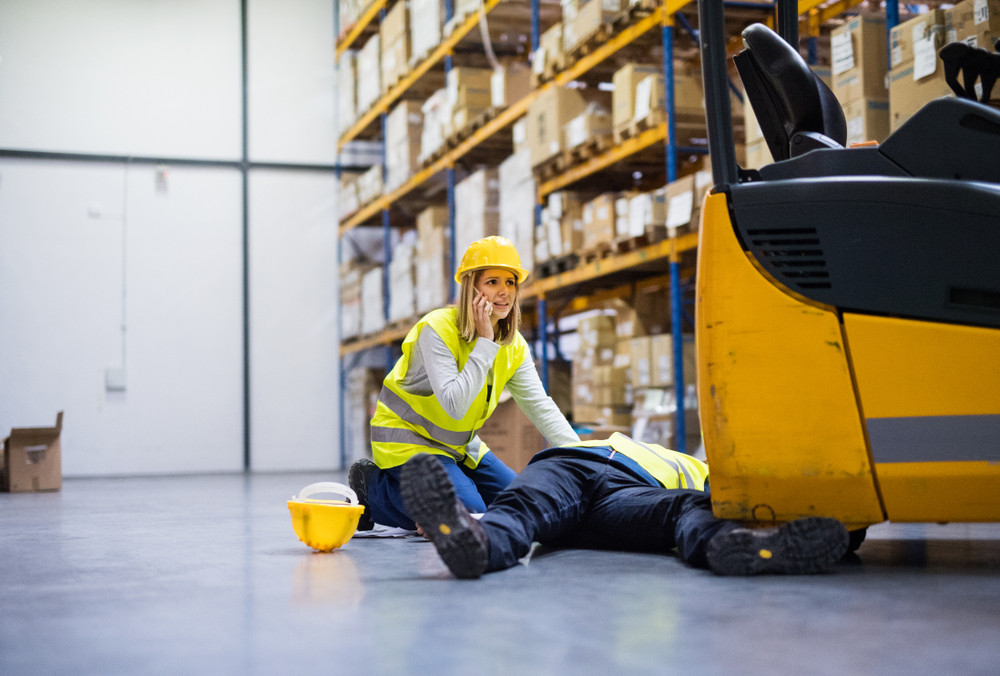
As we push through 2026, the industry is hitting a breaking point. We have faster robots, taller racks, and tighter deadlines, but we are still relying on 1970s technology—beepers and strobe lights—to keep people alive. At siera.ai, we aren’t just looking to add more noise. We’re looking to add intent. Here is the reality of where warehouse safety stands today, the data that should keep you up at night, and the AI shift that is actually saving lives (and margins).
When a safety manager looks at a budget, they see the cost of an AI subscription or a hardware install. What they often miss is the “Iceberg Effect” of a single forklift-pedestrian collision.
| Expense Tier | Description | Estimated Impact |
|---|---|---|
| The Direct Hit | Medical bills, immediate equipment repair, and worker’s comp. | $45,000 |
| The Regulatory Tax | OSHA fines and mandatory third-party safety audits. | $25,000 |
| The Efficiency Drain | Average 48-hour floor shutdown for investigation. | $80,000 (Lost Ops) |
| The Talent Leak | Morale drop leading to turnover (Average $7k to hire 1 driver). | $14,000 |
| The Legal Shadow | Long-term liability and insurance premium hikes (3-year tail). | $36,000+ |
The Bottom Line: A single major accident doesn’t just hurt a person; it can wipe out the quarterly profit of an entire mid-sized facility.
For years, the industry was sold on “Proximity Detection.” The pitch was simple: put a tag on every worker and a sensor on every truck. If they get close, the truck slows down. Here is why that failed in the real world:
The Tag Problem: In a facility with 200 workers and 50 temps, someone always forgets their tag. A safety system that requires 100% human compliance is a system designed to fail.
The “Everything” Alert: Passive sensors don’t know the difference between a concrete pillar and a human being. If the sensor slows the truck down every time it passes a rack, the driver gets frustrated. They start looking for ways to bypass the system.
Human-centric AI—the kind we’ve spent years refining—doesn’t care about tags. It uses Computer Vision. It sees the world like a human does, but it never gets tired, never checks its phone, and never gets distracted. It identifies the “skeletal signature” of a person. It knows that a pallet jack is a tool, but the person walking next to it is a life.
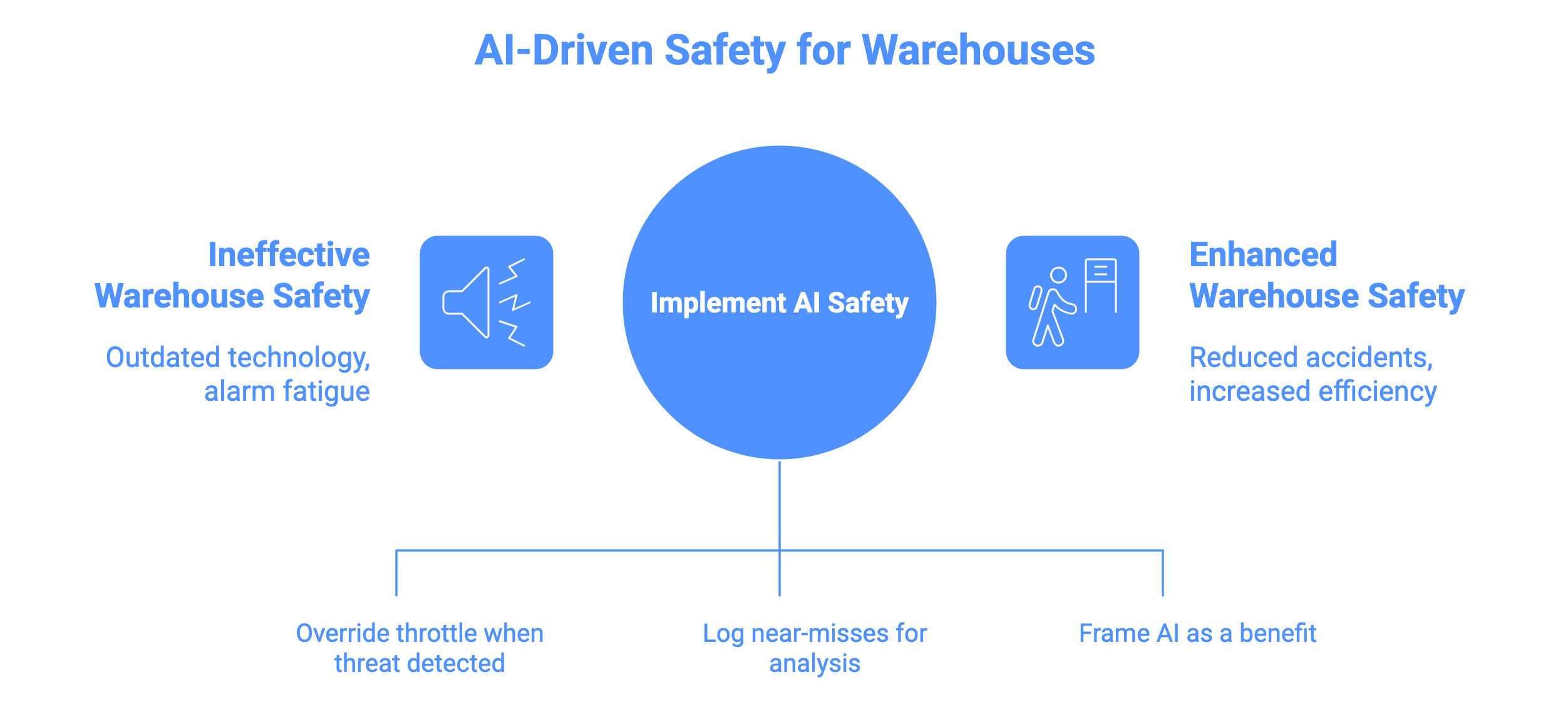
If you’re searching for “how to reduce forklift accidents,” you don’t want to read a 20-page whitepaper. You want the “Zero-Click” truth. Here it is: The most effective way to prevent collisions in 2026 is “Active Intervention.” Detection is useless if it doesn’t result in action. Modern AI safety systems now link directly to the forklift’s drivetrain (Can-Bus). If a human is detected in a “Red Zone,” the system overrides the throttle. It doesn’t ask the driver to slow down; it does it.
Most warehouses suffer from “The Reporting Myth.” A manager looks at a dashboard and sees zero accidents this month and thinks, “We’re doing great.” But what about the Near-Misses? The driver who swerved to miss a supervisor in a blind corner. The pedestrian who stepped behind a reversing lift because they were looking at a clipboard. The “close calls” that happen 50 times a day. In a traditional setup, these are never reported. Why would a driver report a near-miss? It just means more paperwork or a reprimand.
AI changes the culture. By automatically logging every near-miss as a data point, management can see “Heat Maps” of their facility. If the AI shows that 80% of near-misses happen at the intersection of Aisle 4 and the Loading Dock between 2:00 PM and 3:00 PM, you don’t need more “safety posters.” You need to change the traffic flow or the lighting in that specific spot. That is the transition from being a “Safety Cop” to being a “Safety Engineer.”
Operating in the US and Canada brings specific challenges. Labor is expensive, and the legal environment is litigious.
1. The Insurance Pivot: Insurance companies are no longer asking if you have safety tech; they are asking which one. Much like telematics changed the long-haul trucking industry, AI vision is becoming a requirement for “Preferred” insurance rates in the warehouse.
2. The “Experienced Driver” Shortage: We are seeing a massive influx of new, inexperienced drivers. You can’t train 10 years of “gut instinct” into a new hire in a three-day orientation. AI acts as a digital co-pilot, providing a safety net for the “rookie” mistakes that lead to catastrophic failures.
One of the biggest hurdles to implementing AI at siera.ai or any facility is the “Big Brother” fear. Workers think the cameras are there to spy on them. The pivot is simple: Safety is a Benefit. When you frame AI as a tool that ensures everyone—from the picker to the CEO—goes home with the same number of fingers and toes they arrived with, the culture shifts. We’ve seen facilities where drivers actually complain when they have to switch to an older truck without AI. They’ve grown used to the “extra set of eyes.” They feel more confident, which actually makes them faster.
If you are looking at your 2026 goals, here is how you should be evaluating your floor:
Automation of Documentation: Are your daily inspections still on paper? (If yes, they are likely being “ghost-signed”). Move to digital, authenticated checks.
Visual vs. Passive: Does your tech identify people or just objects?
Closing the Loop: When a near-miss happens, do you have video evidence to use for coaching, or are you relying on “he-said, she-said”?
The technology has moved past the “experimental” phase. In 2026, AI-driven safety is simply the cost of doing business well. Are you ready to see what your drivers aren’t seeing? Let’s look at the data together. No fluff, just floor-level reality.
Ready to See What Your Drivers Aren’t Seeing?
Stop guessing and start predicting with a 2026 AI safety audit.
Actually, it’s the opposite. Traditional “passive” sensors cause “nuisance braking”—slowing the truck down for every pallet or wall. Because AI distinguishes between a person and a rack, the truck only slows when there is a real threat. Our data shows that by reducing “false positives,” facilities actually see a 3–5% increase in fleet efficiency because drivers aren’t constantly fighting their own safety equipment.
RFID is a “closed” system—it only protects people wearing tags. What about contractors, delivery drivers, or the office manager walking across the floor? AI vision is “open,” meaning it protects every human regardless of what they are wearing. It removes the “human error” of forgetting a tag or a dead battery.
This is the most common concern on the floor. At siera.ai, we focus on event-based recording. The system isn’t there to watch a 10-hour shift of a driver’s face; it’s there to capture the 10 seconds surrounding a near-miss. When drivers realize the footage can actually exonerate them (proving a pedestrian walked into their blind spot), they usually embrace the tech as a digital witness.
Most facilities see a “break-even” point within 12 to 18 months. This comes from three areas: reduced insurance premiums, lower equipment repair costs (fewer rack impacts), and the elimination of “catastrophic” legal costs. However, the data visibility on near-misses starts providing value on Day 1.
Yes. One of the biggest misconceptions is that you need a brand-new “smart” forklift. Modern AI safety stacks are brand-agnostic. Whether you are running a 10-year-old Yale or a brand-new Hyster, the AI can be retrofitted to the power system to provide the same level of pedestrian detection and telemetry.
Warehouses are messy—we get that. High-quality industrial AI systems are built with IP67-rated hardware. If a lens gets too dirty to “see” clearly, the system is designed to “fail-safe,” alerting the driver that the safety assist is obscured. It’s no different than a backup camera on a car; a quick wipe with a cloth usually has it back at 100% in seconds.